There are so many polls around a US presidential election as the country is curious to know which candidate is most likely to win. These polls are often limited by sample size and can be difficult to get an accurate read on the pulse of such a large population.
To put that audience size into perspective, in 2022, there were 161.42 million people registered to vote in the United States, out of the some 231 million people who are eligible to vote, according to Statista.
Meanwhile, we have access to the data on what is most being searched for on Google, the biggest search engine in the world getting nearly 4.7 billion visitors per day on average. While interest in a candidate and searching for them does not necessarily translate to showing support for the candidate, this is an interesting way to gauge how much traction a particular candidate is generating by being researched and talked about.
We took a look at Google’s search data for the month of October and the first week of November, as the election took place on Tuesday, November 5th, 2024.
First Stop – Ahrefs
According to Ahrefs’ Top Google Searches of October 2024 —

We see the usual sites on the list. youtube, amazon, facebook, etc.
But note that the first news-related query other than ‘weather’ (#9) is ‘fox news‘ at #18, with an impressive 18,970,000 searches.
The next news network-related query in the top 100 is much further down, with ‘cnn‘ at #46, with 10,100,000 searches.
No other news network-related queries appeared in the top 100.
‘Trump‘ came in at #67 with 7,450,000 searches.
For context, ‘Taylor Swift‘ is at #62 with 7,780,000.
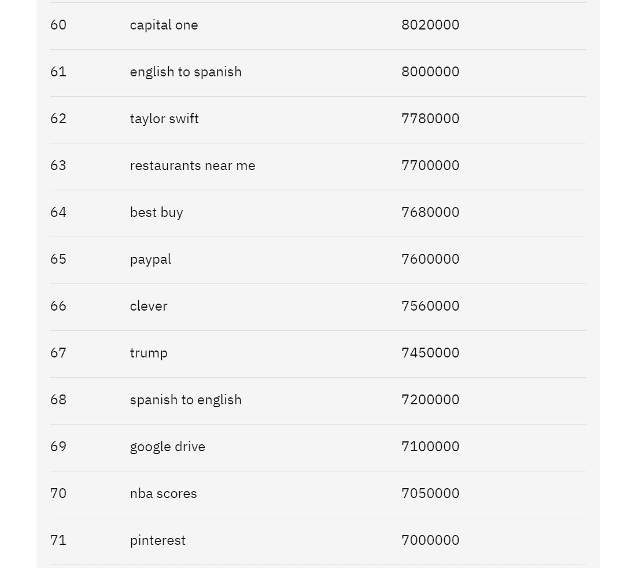
‘Kamala‘ did not make the list.
Our Next Stop is Google Trends
Below, you can see the search trends over the past few months leading up to the election. The big spike there occurs the day AFTER the election, which is most likely people checking to see who won.
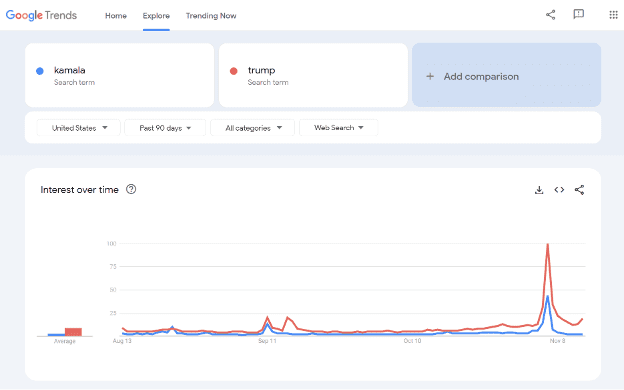
Aside from a small blip on August 23rd, 2024, the day that Kalama Harris gave her acceptance speech to accept her party’s nomination, searches related to Donald Trump have consistently outperformed search intent for Kamala Harris.
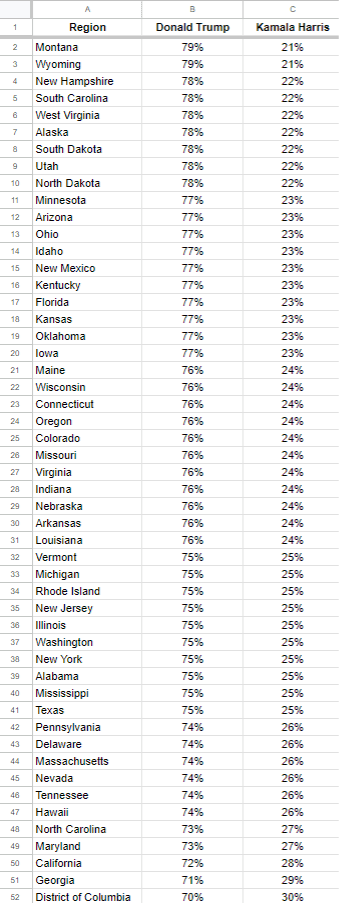
For a more granular look at this, we also broke it down by state to see which candidate the states were more interested in.
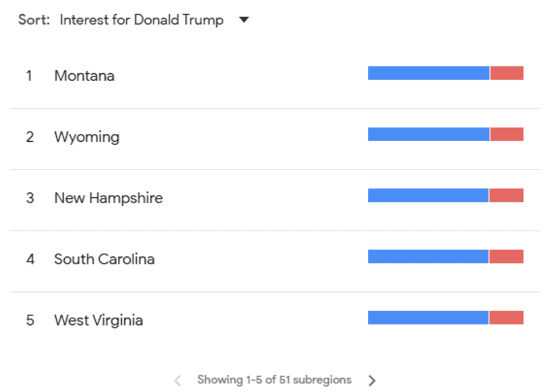
Here is the full list. As you can see, it is fairly consistent across the entire United States within a margin of 9%.
Getting a bit more granular and slightly shifting the focus, we added the topic of the ‘border’ to our query. Google Trends reveals insights that are consistent with media cycles.
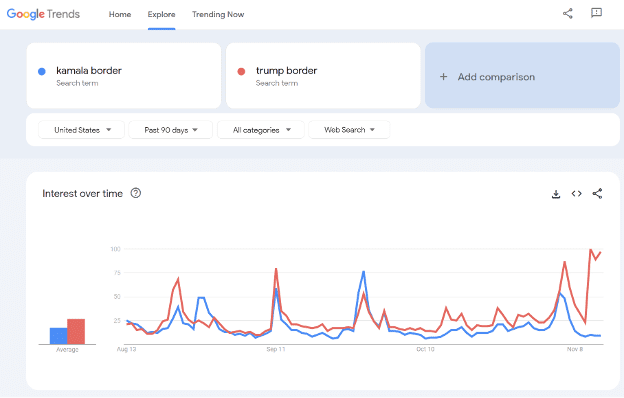
Again, August 23rd shows a spike here, but this time Donald Trump largely has more search interest on this day.
Shortly after, on August 27th, we see another spike for ‘Kamala border’, which is related to her and her VP pick’s first televised interview together.
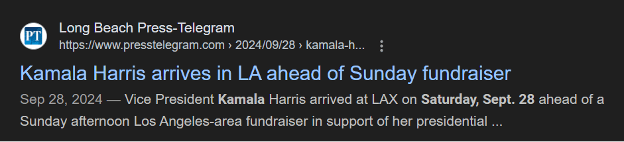
The only other time ‘Kamala border’ search interest is higher than ‘Trump border’ is on September 28th, consistent with the attention around this fundraising event:
You could plug in almost any topic associated with a presidential candidate’s platform and see a similar chart, so I won’t go deeper into the data on that here.
From looking at publicly available data about Google search, it’s quite evident that there was a massive amount more interest in the Trump presidential campaign than there was for his opponent leading up to and during the election.
Analyzing the monthly data of the past 12 months also reveals an interesting trend.
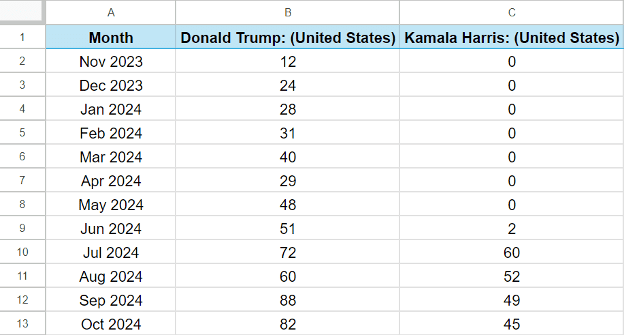
There wasn’t much search interest in Kamala Harris until July 2024, when Biden dropped out of the race and she became the candidate. This enthusiasm and interest seemed to wane from that point and saw a decrease month over month consistently leading up to the election. Donald Trump saw a drop in August 2024, but interest quickly recovered and ended on a high note.
Our Last Stop for Today is Semrush
What was our keyword volume on “Kamala” in the past month?
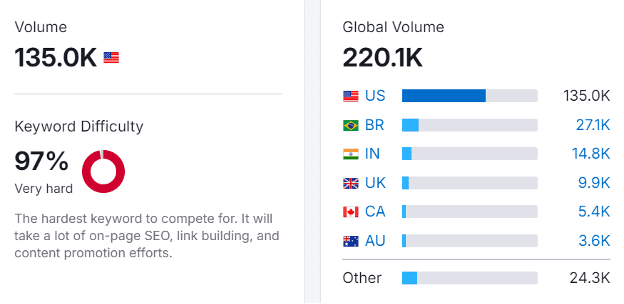
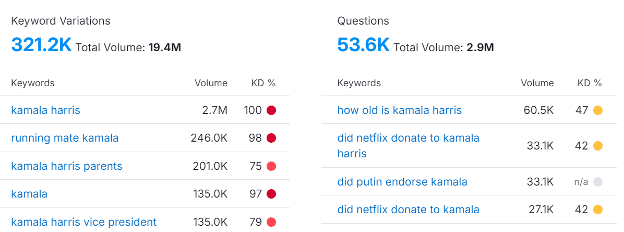
Interestingly, a volume of searches for Kamala Harris were related to her when she was still Biden’s running mate. A story about an executive member at Netflix donating to her campaign really dominated the questions being asked. These stories garnered more search interest than questions about the candidate’s platform and agenda.
And how does this compare to “Trump”?
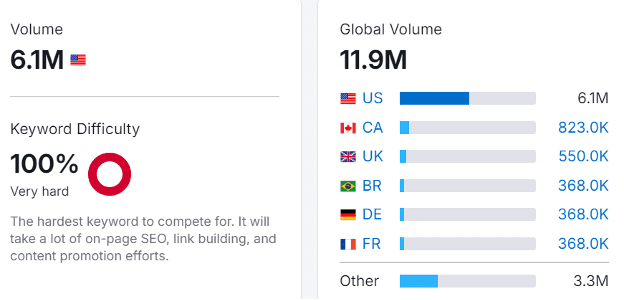
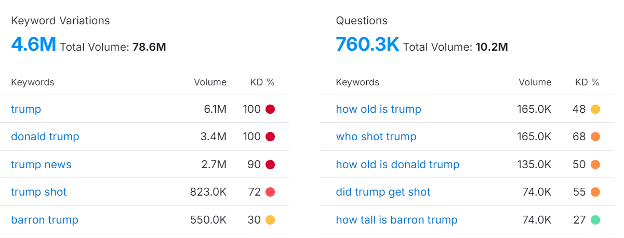
Obviously, way more searches for Trump. However, we can see how some of this is related to his family and not Donald personally. The assassination attempt over the summer also certainly captured the interest and attention of many.
In terms of what other countries are interested in during the 2024 US election, we saw Brazil leading with #2 for Kamala Harris queries and India at #3.
Whereas Donald Trump queries saw Canada at #2 and the UK at #3.
Okay, so the sensational news stories aside, who was looking up the candidates and their platforms?
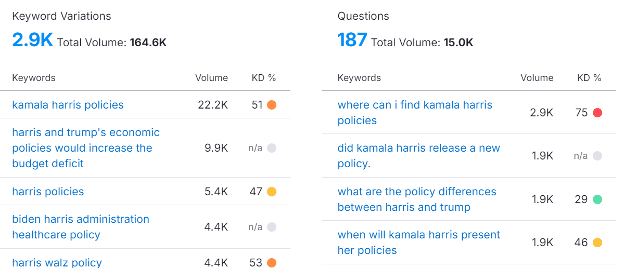
“Harris Policy”
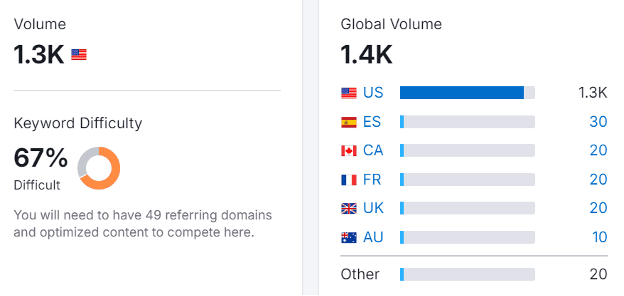
“Trump Policy”
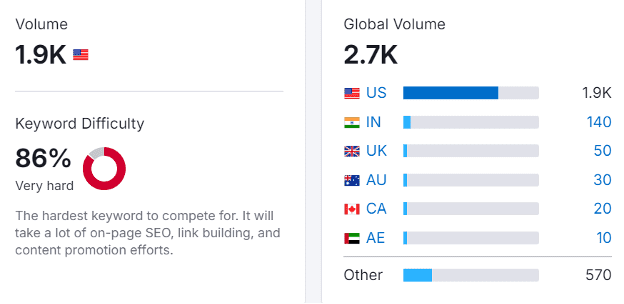
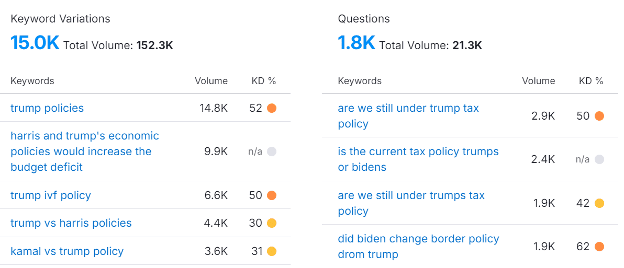
It appears Americans on both sides were equally not that interested in searching Google to learn more about the candidates’ policies. The search volume here comparatively is rather low.
As you can see, Google search data offers us a fascinating window into the minds of voters leading up to an election. While the data trends may provide a snapshot of public interest and sentiment, they stop short of serving as a crystal ball. The granular analysis revealed intriguing patterns—spikes in search interest for certain candidates often correlated with pivotal moments in the campaign trail. Yet, the data also underscored the complexity of voter behavior, where curiosity doesn’t always equate to support and trending searches don’t always predict ballots cast.
While Google may be able to capture a surprising amount of valuable data, it’s clear that the story of an election is shaped by far more than search trends. The data should be viewed as a complementary tool rather than a definitive forecast. As we reflect on the 2024 election, it’s worth asking not just what people searched for, but why—a question that may hold even deeper insights into the intersection of technology, politics, and human behavior in an increasingly digital age.