The Rundown
- Disney is not selling black hat SEO; the viral “disney black hat seo” result was a Google artifact.
- Google likely pulled spammy external anchor text onto Disney’s legitimate login URL.
- A redirect-indexing/cached-title artifact likely preserved the wrong title.
- This kind of misattribution can affect any brand.
- Black hat SEO uses deceptive tactics (fake links, cloaking, spun/AI junk content) to boost rankings.
- Black hat AI SEO targets AI Overviews and chatbots with structured, low-quality sources.
- Short-term manipulation can work, but AI systems are getting better at filtering it out.
- Future AI “trust downgrades” may erase visibility rather than just lower rankings.
Late October brought one of the oddest SEO stories of 2025, as a strange Google search result went viral. When users looked up “My Disney,” one of the top links, which was the company’s legitimate login page, appeared with the title “Black hat SEO packages from…”
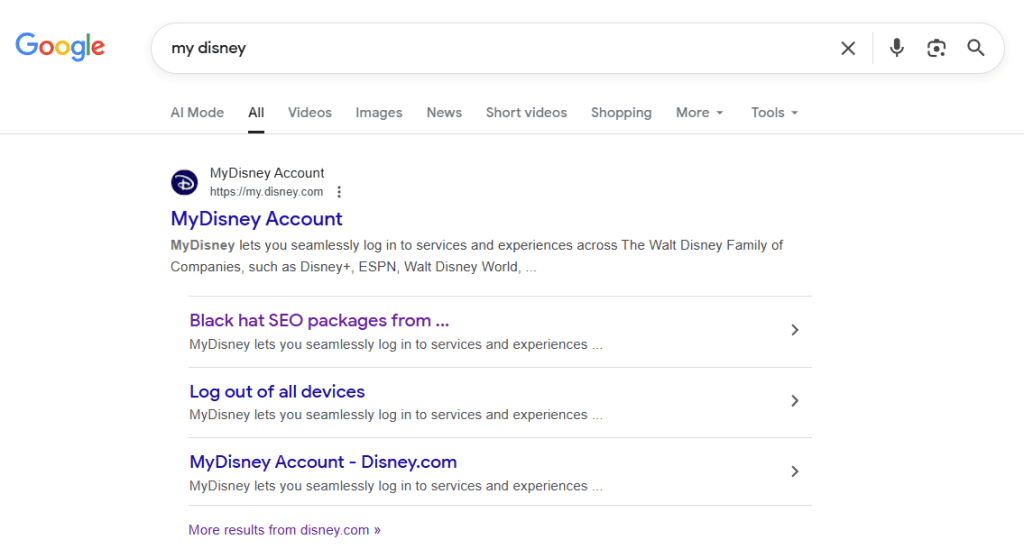
Update: Two days later, it was still not fixed and started showing “Black hat SEO approaches …,” but now it seems to be fixed.
Screenshots flooded social media, and so did the speculation. Some users saying that Disney had accidentally revealed their secret scammy SEO services. Others convinced the company had been hacked.
So what was the real story behind it? Was this really a corporate blunder? A sign that even the biggest brands aren’t immune to digital sabotage? Or was it something else entirely?
Table of Contents
What Even Is Black Hat SEO?
The term “black hat” comes from old Western movies, where villains wore black hats and heroes wore white ones. In the SEO world, it became shorthand for the difference between tactics that tried to manipulate search engines and those that tried to serve them. The goal of both groups was the same: to get visibility. But their methods diverged.
In the early 2000s, search engines functioned as disorganized indexes. There were no real rules, standards, or guides. The people who shaped the early SEO landscape were problem solvers trying to understand how Google decided which pages deserved to rank.
The line between white hat and black hat SEO barely existed. Ranking was built on crude signals like keyword density and backlinks, and that made the system easy to exploit. Many of the same people who now run respected agencies started out testing every loophole they could find.
Then Google got smarter. It started valuing quality, trust, and user experience over shortcuts. What used to be seen as clever optimization started to look like spam. Sites that relied on keyword stuffing, link schemes, or invisible text began disappearing from results entirely, because they were less likely to provide actual value to the users who were searching.
For a while, it really seemed like black hat SEO was on its way to complete extinction. Google patched most of the easy gaps. Penalties became severe, and white hat best practices became the default. The industry matured.
But history has a way of repeating itself, and the old tricks are creeping back in.
Black Hat AI SEO
Many of the old guard of SEO thought leaders are quietly dusting off their black hat robes. Many of the same people who built careers preaching white hat best practices are now experimenting with manipulative tactics similar to the ones they used twenty years ago. What happened? AI happened.
Tools like Google’s AI Overviews, AI Mode, ChatGPT, Perplexity, and other generative engines are changing how information is found and ranked. Instead of focusing only on search results, brands are now trying to appear inside AI summaries and chatbot responses. It’s a completely new system to understand, and wherever there’s a system, there are people eager to exploit it.
AIs frequently cite pages that do not rank in the top organic results from traditional Google search. That by itself is not a problem, but it also means that the quality standards are not the same.
For example, when asking ChatGPT for “Best Running Shoes 2025,” you might get a list that looks credible at first, only to later realize the source it’s citing is a retailer’s blog, ranking its own product in the top spot. To a human, that reads like obvious self-promotion aimed at gaming the system. Traditional search engines recognize this pattern and tend to favor more independent review sites. But to an AI system scanning for relevance, structure, and product entities, it looks like a neatly formatted source. When enough of these self-referential roundups exist, they start shaping the summaries AI models generate.
Some black hat SEOs are building spam-heavy content networks aimed at flooding AI training datasets. Others are manipulating backlinks, citations, and entity data to influence what AI systems choose to summarize or recommend. In other words, tricking AIs is not that hard. So much so that scammers were able to plant fake customer-service numbers across the web, and when a traveler searched for a cruise-line help desk, Google’s AI Overviews and ChatGPT both presented one of those fake numbers as legitimate contact information.
With AI search tools still early in their training phases, with crude filters and a shallow understanding of reputation, these black hat AI SEO (also known as black hat GEO) tactics are working.
But you can quote us on this: it’s only temporary.
Want real SEO and AI SEO results without the shady tactics?
Frequently Asked Questions
Was Disney’s website hacked in October 2025?
No, Disney’s website was not hacked. The “Black Hat SEO packages from Disney” result appeared because Google temporarily misattributed spammy anchor text from external links to Disney’s login URL. It was a search indexing glitch, not a security breach.
Why does Google show ‘Black Hat SEO packages from Disney’ in search results?
Google’s algorithm sometimes rewrites page titles using external anchor text. In this case, spammers likely linked to Disney’s login page with the phrases “Black Hat SEO packages from…” and “Black hat SEO approaches …,” and Google’s system mistakenly used that text as the title. The result was an indexing artifact, not content created by Disney.
Can AI search results like ChatGPT or Google AI Overviews be manipulated?
Yes, but with a caveat. AI search tools can be influenced by low-quality or self-promotional sources that appear structured or credible. Scammers and black hat SEOs can even plant misleading data, fake reviews, or fabricated contact information that AIs may repeat as factual summaries, but these manipulations rarely go unpunished. As AI systems learn to recognize authenticity, reputation signals, and verified sources, they filter out unreliable data and reduce the visibility of deceptive content over time. In severe reported cases, companies like OpenAI and Google also perform manual removals to eliminate known scams or false information from their results.
Can my website or brand be penalized by ChatGPT?
Not yet in the traditional sense, but likely coming in the near future. As AI-driven search systems mature, they will start downgrading or excluding sources that appear manipulative, low-quality, or untrustworthy. Just as Google penalized sites that relied on black hat SEO (keyword stuffing, fake backlinks, or AI-generated spam content), AI models will eventually filter out brands that try to game their summaries or citations. When that happens, the effect could be even harsher than a ranking drop: your brand might simply stop appearing in AI responses altogether. Maintaining clean technical SEO, accurate structured data, and credible reviews will be critical to staying visible in future AI ecosystems.
Why Will Black Hat AI SEO Backfire (Again)
If there’s one constant in SEO history, it’s that manipulation never goes unchecked for long. And short-term black hat tricks only work until they don’t.
Google spent years learning to detect black hat tactics, and each new generation of their algorithm punished those who took shortcuts more and more.
There’s no reason to believe that the same won’t happen with AI-driven search.
The companies building these new engines, including OpenAI, Anthropic, Perplexity, and even Google itself, are all actively training their systems to recognize authenticity and reputation signals. Not because they care about fairness, but because better answers keep users engaged longer. Engagement drives subscriptions, ads, and investor confidence, leading to more revenue, which is what ultimately guides their decisions.
It might take them a little while to catch up, but they will get there.
And when they do, the punishment will sting far worse. On the old web, a penalty knocked you down the rankings. In the AI era, a trust downgrade can wipe your presence from the model entirely.
So is Disney Really Selling Black Hat SEO Services?
Which brings us back to Disney. And the short answer is simple, even if not that exciting: no, they did not start a black hat SEO services division. Nor were they hacked.
What actually happened is simpler and far less scandalous. It’s a Google indexing artifact, and it’s a fascinating example of how AI-driven search systems can misattribute metadata.
The phrase “Black hat SEO packages from…” showing under Disney’s official login page isn’t content from Disney’s site, it’s content that Google associated with that URL.
Google sometimes rewrites titles in search results1 based on anchor text from external links2. If a spammer linked to https://my.disney.com/account using anchor text like “Black hat SEO packages from…”, and Google’s algorithm misinterpreted that as the most relevant description for the URL, it can overwrite the title that normally appears (“MyDisney Account”). This doesn’t require any hack or vulnerability, it’s a ranking artifact caused by manipulative backlinks.
Another possibility is that the /account endpoint might have at some point been used as or included a redirect, like: my.disney.com/account?redirect=https://otherdomain.com
Spammers can trick Google into indexing that redirect URL3, attaching their own page title (“Black hat SEO packages from…”). Even after Disney patched it, Google’s cache could still be displaying that old metadata.
Even if that was already cleaned or if Google’s systems reclassified the page, the visible result could show the correct URL and domain but still with the incorrect title text for several days. This mismatch between title and destination is a known Google SERP quirk during cache refresh cycles.
Could a black hat SEO company have been behind it? Possibly. It’s not hard to imagine one of two scenarios. The first is that it happened unintentionally, as part of an automated system that constantly searches for and deploys new exploits at scale. The second is that someone noticed the opportunity and used it deliberately, hoping to earn attention or credibility within the black hat SEO community.
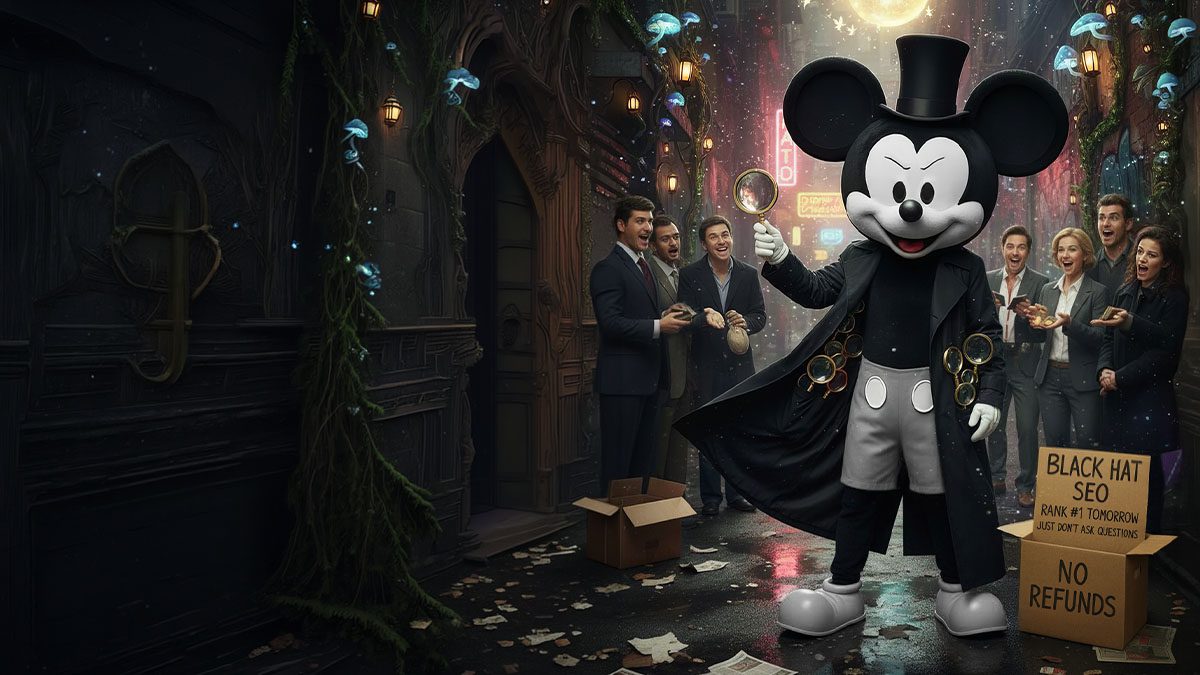
To capture the absurdity of it all, we reimagined the Disney-SEO mix-up as a digital fairy tale gone wrong:
The Lessons for Brands
The Disney incident is a reminder that even the world’s biggest brands can become collateral damage in someone else’s spam experiment. It highlights the importance of maintaining secure servers, keeping CMS platforms and plugins up to date, and tightening access to admin accounts. A small vulnerability or misconfiguration can make any site, no matter how reputable, an unknowing participant in someone else’s shortcut.
It also shows how fragile manipulative tactics really are. The same systems that can be tricked today will adapt tomorrow, often turning quick wins into lasting penalties. That’s why it’s better to invest in strategies built to last. At Coalition Technologies, we help brands strengthen their visibility and reputation in both traditional and AI-driven search, staying ahead of the next algorithm shift instead of chasing it. If you’re ready to build a durable, trustworthy SEO and/or AI SEO plan, reach out today.