
Key Takeaways
- B2C SaaS SEO targets individual end users, appealing to emotional responses and impulse purchases.
- Optimize content with keywords selected based on the stages of the sales funnel: Awareness (ToFu), Consideration (MoFu), and Conversion (BoFu).
- ToFu keywords target broad, high-intent searches.
- MoFu keywords highlight comparisons, case studies, and demos to influence buyer choice.
- BoFu keywords emphasize brand terms and direct sign-up landing pages.
- Create authoritative content to generate relevant leads and establish trust.
- The website should be optimized for desktop and mobile users, including both humans and AI.
B2C SaaS stands for business-to-consumer software as a service, and SEO for this kind of company requires a specialized approach. While search engine optimization fundamentals still apply, strategies must be fine-tuned to capture a unique customer base. You’re not marketing to a committee of shareholders; you’re trying to reach individuals.
Globally, spending on SaaS is estimated to hit $295 billion in 20251, yet approximately 88% of that revenue goes to B2B providers.1 This disparity highlights the vast potential for B2C providers to stand out in a market that’s much less saturated. That remaining 12% may seem like a small number until you realize we’re still talking about an underserved $35 billion market!
In this blog, we’re going to explain why B2C SaaS digital marketing is crucial to your short- and long-term success and highlight actionable strategies. First, let’s cover the basics.
Table of Contents
Frequently Asked Questions
What is the difference between B2B and B2C SaaS?
B2B SaaS providers sell to other businesses; B2C SaaS providers sell to individual end users.
What is B2C SEO?
B2C SEO is a specialized approach that targets high-intent searches and uses a direct-to-consumer sales funnel. While B2B optimization often focuses on concrete, value-driven marketing, optimizing for consumers usually appeals to emotions and focuses on impulse buying.
What is the B2C SaaS funnel?
A business-to-consumer funnel is a multi-step marketing strategy that an SEO agency uses to improve the odds of a consumer becoming a long-term customer. Here’s what a basic version of a business-to-consumer funnel looks like:
- Top: Awareness (getting eyes on your service)
- Middle: Consideration (the consumer compares your service with the competition)
- Bottom: Conversion (the consumer subscribes)
- Ongoing: Retention (keeping the customer happy)
How B2C SEO Differs From Traditional SEO
It’s important to note that there will be overlap between the techniques used for standard SEO and those used for B2C SaaS SEO. For example, creating authoritative content, getting backlinks, keyword research, and improving UX (user experience) for both desktop and mobile apply to both approaches.
However, the big difference is that SEO for B2C SaaS companies focuses on getting the searcher to sign up, rather than just driving more traffic to your website.
For example, the SEO might put a stronger emphasis on getting eyes on your case studies and reviews. And rather than directing searchers to a product page, the goal could be to direct them to a free demo or trial of the software and encourage them to test it out.
Need a highly specialized campaign for your B2C SaaS company? We can help.
Keyword Strategies for the B2C Marketing Funnel
Keyword research and practical implementation aren’t the only strategy by any means, but it’s a big one. Let’s explore how the keywords will differ depending on which stage of the funnel you’re targeting.
Top-of-the-Funnel (ToFu): Awareness
At the top, you’re targeting broad, high-intent searches about the type of software you offer. The searches aren’t related to your brand or product, but they’re closely connected.
Let’s say you create accounting software. As you can see below, “accounting software” is a highly saturated keyword.
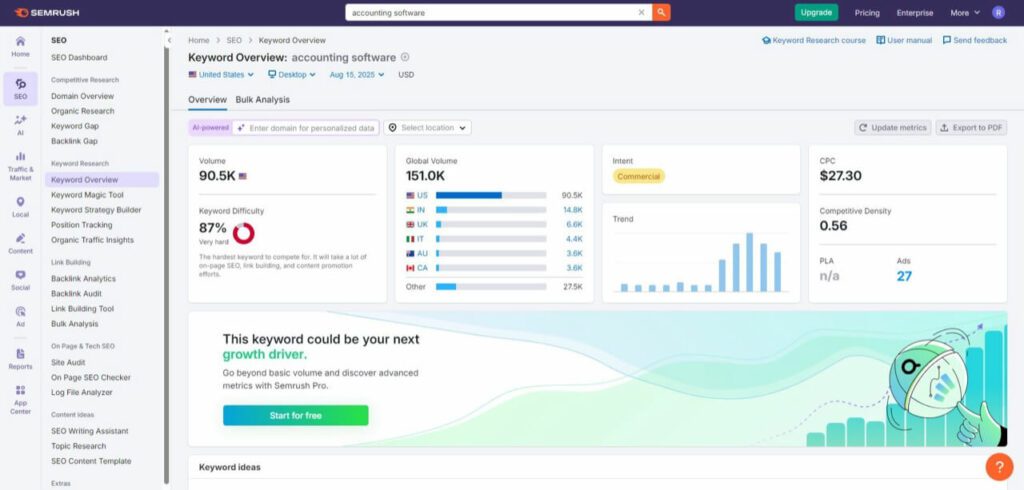
Although high competition doesn’t necessarily mean you should abandon a keyword entirely, a B2C SaaS digital marketing strategy could involve targeting a smaller niche, like “basic accounting software,” for example.
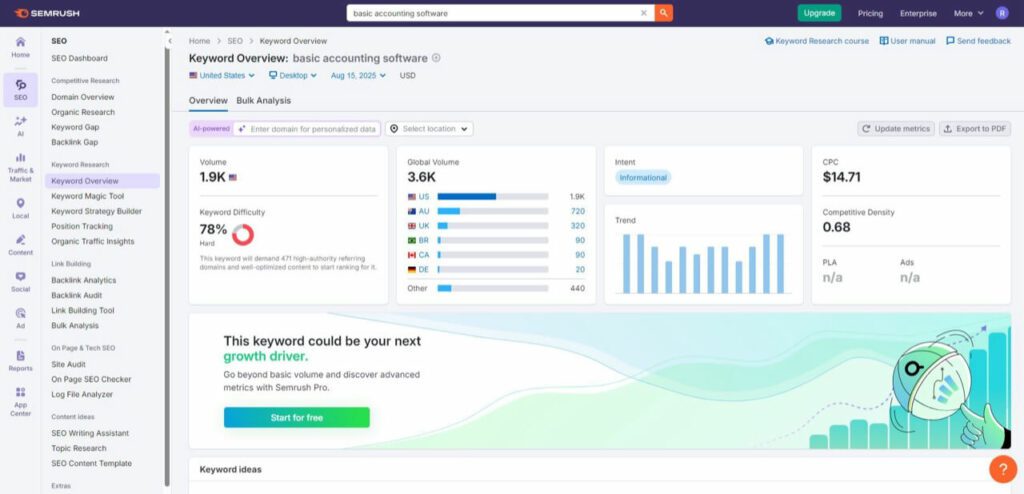
Adding the word “basic” allows you to target a more niche demographic: individuals who are seeking simple, no-frills accounting software.
As a B2C company, attempting to compete with B2B giants can be a fool’s errand. The goal isn’t to establish your brand as the world’s #1 accounting software company, but to capture the interest of individual consumers who are seeking a specific type of software.
Where the keywords are placed matters, too; you’re not aiming for the conversion just yet. A B2C SaaS SEO agency may use ToFu keywords to guide the searcher to a blog post, video, or guide. The idea is to introduce your brand and provide a broad overview of what you bring to the table.
Middle-of-the-Funnel (MoFu): Consideration
At this stage of the funnel, the searcher is researching their options with more specific queries. They’re aware of your brand, but they’re not committed. They may be researching other software and weighing the pros and cons.
For example, instead of just searching for “basic accounting software,” they may search for “accounting software for freelancers.” They have a few options for no-frills accounting software in mind, but now they’re looking for basic software specifically for freelancers.
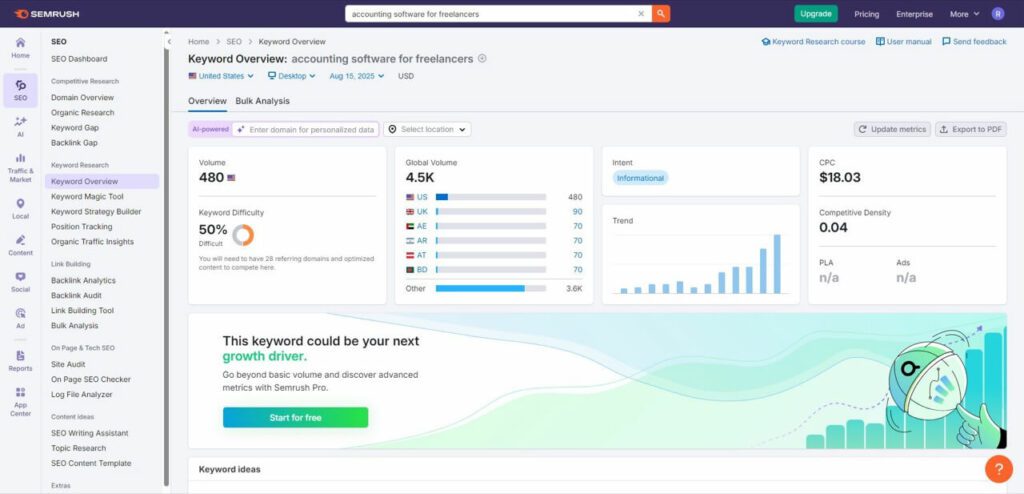
The competition isn’t as fierce for this narrower query, so this is an opportunity to make your value propositions clear and stand out from the competition. At this stage, SEO for B2C SaaS could involve optimizing for case studies, testimonials, demos, and product overviews.
Bottom-of-the-Funnel (BoFu): Conversion
At this stage, the searcher has learned about your brand and software. There’s a good chance that your brand or software name is included in their searches. They’re close to making their final decision, but their research is getting more specific. They just need a nudge in the right direction.
At the bottom of the funnel, you want to make it easy for the consumer to convert, which in this case, usually means signing up for a subscription. A B2C SaaS digital marketing could direct them to a simple, conversion-centered landing page with a sign-up form.
It might be tempting to optimize for long, highly detailed keywords at this stage, and the conversion rate can be higher, but proceed with caution. If your keywords aren’t broad enough, you could miss out on a large market. On the other hand, if they’re too narrow in scope, you’re going to reach a relatively small number of consumers.
The average length of a search query in the United States is 3.4 words.2 Long-tail keywords aren’t inherently bad, but they can sound unnatural and often have a low search volume. That’s just one of many reasons why you must partner with a B2C SaaS SEO agency that has deep knowledge and experience. Keyword selection is both a science and an art form.
Generate Relevant Leads With Authoritative Content
Keywords are only helpful if you have top-tier content to back them up. 59% of B2C marketers cite creating high-quality content as the most effective strategy 3
For a SaaS company, regularly updating an expert blog can be incredibly beneficial. Not only does it provide an outlet where you can place your keywords, but the content simultaneously establishes your brand as an authority and educates the consumer about what makes your software so special.
While you can certainly sprinkle some marketing into your blogs, the goal isn’t just to sell your software; it’s to provide actual value to the reader. SEO for B2C SaaS isn’t just about getting the searcher’s attention. It needs to engage them and get them to stick around. From there, the conversion happens naturally as they realize that you’re the real deal.
Beyond the blog, your overall web presence needs to prove that you’re a leader in your field. Software is a dime a dozen these days. You need to make it abundantly clear that you have that elusive “it” factor.
Let’s use our client, FC Engineering Services, as an example. They make internet and telecommunications software. When we built their website, we added a dedicated Expertise section that proves beyond a shadow of a doubt that they’re a top-tier company.
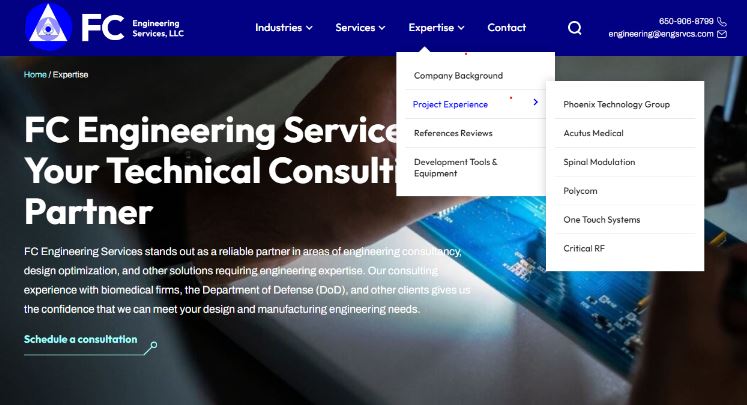
Leveraging our experience as a world-class B2C SaaS SEO agency, we created four distinct subsections that showcase the company’s expertise: an overview of the company, their experience and case studies, their references and reviews, and the tools and equipment they use.
Don’t Overlook Technical Optimization
A solid B2C SaaS digital marketing strategy is useless if your site runs like molasses on a cold day! This is especially true in the context of SaaS. After all, how can consumers trust your tech prowess if your website is sluggish, glitchy, and unappealing as a whole?
Your website needs to be easy to navigate, not just for individual users, but for LLMs. These days, AI SEO is a vital component of an effective SEO campaign. Nearly half of online shoppers use AI models.4
Often, this form of conversational research leads to zero-click searches, but getting cited by LLMs can still significantly increase brand awareness, visibility, and recognition, which are critical elements of lead generation. As AI agents become more prevalent, SEO for B2C SaaS must adapt to non-human shoppers who convert on the end user’s behalf.
Finally, don’t forget about mobile optimization. Over 60% of U.S. searches happen on a mobile device.2
Partner With an Elite SEO Agency
Generating leads that convert requires a level of expertise few possess. Fortunately, you’re in the right place. Our SaaS SEO services consistently create tangible value for our clients. The global SaaS market is poised to generate nearly $819 billion in 2029.2. Now is the time to plan for your company’s future. Get in touch for a free consultation.
Resources:
1. https://www.semrush.com/blog/saas-statistics/
2. https://www.semrush.com/blog/google-search-statistics/
4. https://finance.yahoo.com/news/nearly-half-us-consumers-ai-070000052.html?guccounter=1