



The Roundup
In this quick Coalition Technologies overview, you’ll learn more about:
- Data-driven ad strategies use customer behavior data, automation, and performance insights to personalize messaging and allocate budget based on measurable results.
- Google Local Services Ads (LSAs) are pay-per-lead placements that appear at the top of search results for local service queries.
- Google LSAs prioritize proximity, review ratings, responsiveness, and profile completeness when ranking local providers.
- Profile optimization, review acquisition, service-area refinement, and fast response times improve Google LSA performance.
- Common Google LSA mistakes include slow response rates, failure to qualify leads, and overly broad service targeting, which reduce efficiency and waste ad spend.

Data-driven advertising is quickly becoming the standard for local service businesses looking to generate consistent, qualified leads. This may be mainly because of the immense benefits they offer businesses, especially local service providers.
It is okay if all of this seems foreign. For a better understanding, this guide will explain everything and deeply examine a fantastic example, which is Google Local Services Ads (LSAs).
Table of Contents
- 1 What are Data-Driven Ad Strategies?
- 2 Traditional vs Data-Driven
- 3 What are Google Local Services Ads?
- 4 Who Can Use Google Local Services Ads
- 5 FAQs
- 6 Location Matters
- 7 Levers that Improve Results
- 8 Most Important KPIs
- 9 Common Mistakes that Waste Spend in Google Local Services Ads
- 10 Grabbing the Opportunity with Both Hands
What are Data-Driven Ad Strategies?
According to Forbes, around 67% of Gen Z and Millennials¹ wish to have personalized offers all the time.
What better way of doing so than data-driven ad strategies?
The term refers to a method of delivering ads by making use of several data forms and insights, AI, and automation. A careful analysis of customer trends, behaviors, and more is conducted, and the ads are then tailored to suit exactly what they are looking for.
Traditional vs Data-Driven
Here are some of the ways in which data-driven ad strategies separate themselves from the traditional ones.
| Metric | Traditional | Data-Driven |
| Audience | The target audience is rather broad, as there is no specificity. | The ads are personalized for particular people based on things like behavior |
| Message | Messages are generic so that they can fit all. | The target audience is precise, so the messages are designed for each one. |
| Decision Making | The decisions made here stem primarily from creative actions. | Just like the name, data is the key element in steering decisions. |
| Time | There is a pre-defined campaign with rigid timelines for achieving the goals. | Optimization here is done in real time. |
| Funds | Ad money is based on intuition and precalculations. | Performance is the driving force for the money used |
What are Google Local Services Ads?
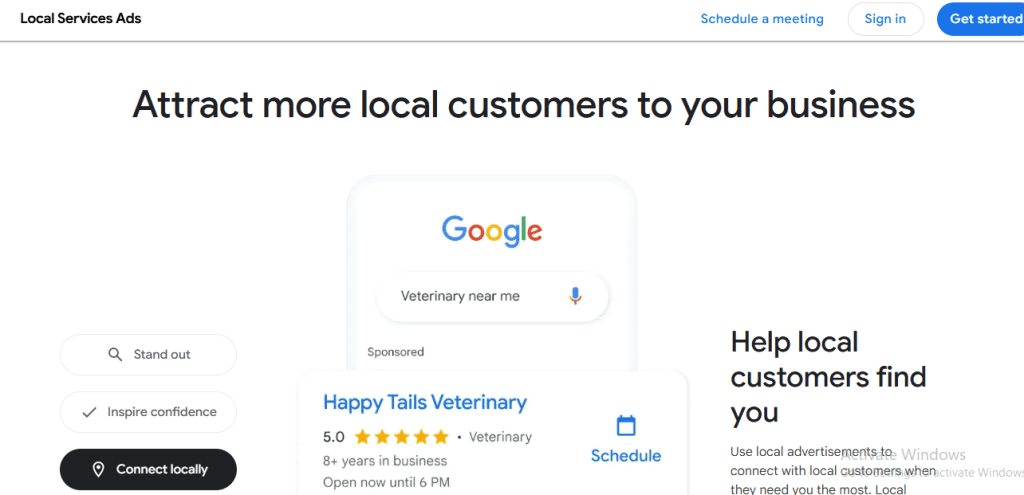
Google Ads have been in use for some time and are quite popular in the marketing world. Although it was launched a while ago, many may not be familiar with Google LSAs.
So what exactly is it?
In simple terms, these are ads that show up at the top of search results when someone inputs a query for a service in their area. Unlike Google Ads, they are pay-per-lead.
Local Google Ads help foster lead-related activities for the ultimate benefit of the service provider. Some examples include: filling out forms, calls, messages, and booking of appointments.
Who Can Use Google Local Services Ads
If your business falls under any of these categories, you are eligible to use the Google Ads for local business offering. These include;
- Home – moving and contracting service providers fall here.
- Health – dentists are excellent examples.
- Automotive – firms dealing with auto body issues.
- Beauty – hair salon owners are free to run local Google Ads.
- Wellness – massage spaces/firms.
- Care – pet training, animal shelters.
- Learning – tutors.
- Business – real estate agents and accountants are eligible to run the ads.
FAQs
How do LSAs differ from traditional Google Ads?
Google Local Services Ads (LSAs) operate on a pay-per-lead model and appear at the very top of local search results. This means that businesses are charged when a customer contacts them. Traditional Google Ads, however, use a pay-per-click model, require keyword bidding, and send traffic to landing pages for conversion.
How does local intent differ from ecommerce or B2B?
Local intent searches are driven by immediate service needs within a specific geographic area. Ecommerce searches focus on product comparison and online purchases, while B2B searches typically involve longer research cycles and multiple decision-makers.
How do I improve LSA performance?
LSA performance improves with strong reviews, fast response times, accurate service area targeting, and a fully optimized Google Business Profile. Monitoring charged leads, disputing invalid leads, and tracking cost per lead and bookings also help maintain efficiency and improve return on ad spend.
Should I use LSAs or standard Google Ads?
LSAs are ideal for service-based businesses seeking high-intent local leads with a pay-per-lead model. Standard Google Ads offer more control over targeting, messaging, and broader keyword coverage. Many local businesses benefit from using LSAs for direct leads and Google Ads for additional reach and remarketing.
Want better results from your local ads?
Location Matters
Local intent refers to a person’s goals when they are on a device, looking for a certain thing in their geographical region.
A closer look at how the space operates and the differences start showing. Here are some reasons why:
Limited Service Areas
The performance of Google Local Services Ads is highly influenced by location. This essentially means that when entering a search query for a service, the provider whose location is closer to the person is given top priority.
Immediate Needs
A major driver of local Google Ads searches is the need of the person behind the query.
Based on the search query, the results shown are relative to one’s urgent/immediate service needs.
Trust Heavy Decisions
Prominence and trust are key factors in this space. Ask yourself, is your business appearing, or does it seem authoritative?
Things like reviews, ratings, proximity, etc., are taken into account by Google’s rankings. That is why when using Google Ads for local business growth, you should take such things seriously.
Levers that Improve Results
Here is what you should do to get better results in the Google Local Services Ads space;
- Make Proper Use of Google Business Profile – ensure that your profile is complete and all the information is correct. Update it regularly and go the extra mile by adding relevant photos.
- Focus on your locale – make sure that the people your local Google Ads are targeting are as close to you as possible.
- Seek reviews – ask previous customers to leave reviews. Doing so plays a key role in being on Google’s “good side.” Once done, go further and engage with the reviews left.
Note: Good/great reviews are crucial. Stats show that 78%² of people are reluctant to choose businesses that have fewer than 4 stars.
Most Important KPIs
A key part of knowing how to correctly run Google Ads for local businesses is taking note of the key performance indicators.
Here are some of the main ones you should monitor:
- Return on Ad Spend
The amount of money or revenue that has come in as a result of running ads.
If, for example, you spent $600 on ads and got a total revenue of $3000.
This basically means that your return when using Google Ads for local business growth is 5X.
- Total Bookings
When one gets leads from Google LSAs, the next step is often taking bookings. Now, the number of people who move from lead to appointment is what is being looked at here.
This shows whether or not the ads are bringing in actual customers/business.
- Total Charged Leads
Another KPI to help guide growth when using Google Ads for a local business is the total number of leads received that one was charged for.
- Cost per Lead
This is the amount of money it took on Local Google Ads to actually get an individual who could potentially be a customer.
Common Mistakes that Waste Spend in Google Local Services Ads
- Poor Response Rates – a lot of people using Google Ads for local business growth often fail to offer prompt responses, which could cost you leads and eventually revenue.
- Not Qualifying Leads – failing to qualify leads often means that one might lose them later on in the pipeline, which would mean that ad money was wasted.
- Being too Broad – widening the area of service easily translates to a waste of money because one will most likely not get the leads they wished for.
This is something service providers should take note of because reports show that businesses in the local map pack are said to receive more traffic, 126% to be precise³.
Grabbing the Opportunity with Both Hands
Data-driven ad strategies like the Google Local Services Ads, although different, go a long way in redefining the advertisement space and offering immense benefits to local businesses. It is therefore essential for service providers to jump on the train so that they are not left behind. With the above Google Local Services Ads Guide, one should be able to find their footing.
With years of experience in the ads industry, Coalition Technologies is here to help improve your LSA results. Reach out to us today and feel the difference.
Sources:
- David Doty, A Reality Check on Advertising Relevancy and Personalization (Forbes)
- Cecilia Meis, 34 Local SEO Statistics You Need to Know (Semrush)
- Meis, 34 Local SEO Statistics.