



The Rundown
- Shopify has announced to merchants that many will be live in AI checkouts by the end of January 2026
- Your products can now be sold directly inside AI tools, not just on your site
- The checkout experience is handed off (in part) to AI platforms like ChatGPT, Google, and Microsoft. The store owner stays on as a merchant of record with branding and catalog control managed predominantly through their Shopify store.
- Fees are TBD for ChatGPT, with Google and Microsoft confirmed to be free at launch. The rumored 4% for OpenAI was based on beta participants.
- This is another step towards AI and LLMs behaving like marketplaces, not channels. AI SEO (GEO) and AI PPC (TBD) become extremely important.
Many Coalition merchants began receiving notice from Shopify on January 12, 2026, telling them they are auto-opted in to agentic shopping experiences with major AI and LLM platforms. This was news that Coalition has expected for some time, talking about it as far back as last summer. Shopify has confirmed that US merchants focused on US buyers, who are currently enabled for Shopify Catalog made up this group.
From Coalition’s perspective, a key takeaway is that Google AI Mode and ChatGPT will increasingly behave like marketplaces, surfacing relevant products, content, and promotions, to end shoppers, who will complete their full purchase within the AI. We’ve referred to that widely as the ‘webless web’.
We reviewed Shopify’s published agentic shopping terms and conditions to identify any ‘gotchas’ that could exist for merchants that may need to be identified before they go all in on their ecommerce AI SEO and whatever AI ad campaigns the LLM companies may eventually offer.
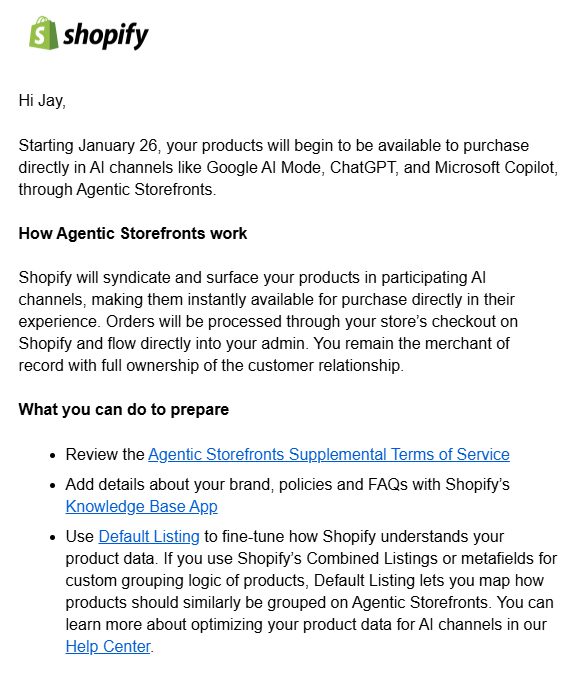
Table of Contents
- 1 What Shopify actually changed
- 2 Frequently Asked Questions.
- 3 Branding and checkout control, mostly gone
- 4 Fees will be stacked, not substituted
- 5 Liability stays with the merchant
- 6 Data sharing and privacy complexity
- 7 Partner terms you probably did not read
- 8 Automatic enrollment and opt-out reality
- 9 Final take
What Shopify actually changed
Shopify is rolling out agentic shopping across platforms like Google, Microsoft, and ChatGPT. These systems can present products, answer questions, and complete checkout without sending users to your storefront.
In essence, for LLM shoppers, Shopify steps into the background as a data feed and catalog management system, supporting AI checkout experiences.
For merchants, and consumers within it, the AI checkout experience means your website is no longer the primary point of interaction. Instead, like some existing offsite transactions, Shopify will operate as a OMS/ERP-like solution that helps with managing product content and promotions, while fulfilling orders.
Merchants who opt out, will have customers pushed back to their store via clickable links. (ChatGPT has said that opting out of checkout may impact what products are recommended and we expect Google and Microsoft to take similar stances).
Frequently Asked Questions.
What is an agentic storefront?
An agentic storefront allows users of AI systems like Google, Microsoft, or ChatGPT to complete checkout in the LLM systems, using Shopify as the backend. The customer may never see your actual website. From their perspective, the AI is the store. Shopify’s partners have committed to making clear to purchasers that the transaction is with the merchant, and will include branding elements like the merchant’s name, logo, and policies before the transaction is completed.
Am I automatically opted in?
In most cases, yes. If you are set up to sell in the US to US audiences, and are setup with Shopify Catalog, then you are part of the original go live group. Shopify determines eligibility and enables participating partners by default. Opting out requires manual action in your Shopify Admin.
Do I still control my branding and checkout experience?
Yes and no. Your logo and name will be visible in these experiences. Per Shopify, there is an expectation that the use of the Knowledge Base app will not only help with product accuracy, but also with maintaining brand voice. Participating partners can override your checkout branding, layout, and extensions. Your custom UI, upsells, and post-purchase flows may not appear.
Who is liable if something goes wrong?
You are. Even if the AI agent misrepresents a product or delivery promise, you remain the seller of record and handle support, disputes, and chargebacks. Shopify is aiming to ensure that their shared initiative with these LLM partner is merchant friendly, so expect them to respond if Google, Microsoft, or ChatGPT solutions tend to lead to heightened misrepresentations of brands or products.
Are there new fees?
Yes. At the moment, ChatGPT is believed to be the only LLM launching with new fees. The negative press reception to their fee structure (4% of transactions was rumored) could mean that changes prior to or after launch. Agentic storefront fees are charged on top of the existing Shopify subscription, transaction, and payment processing fees. Fees for canceled and refunded orders will be refunded to the merchant, including ChatGPT’s transaction fee.
Can I opt out later?
Yes, manually, via an admin toggle Even then, your products may still be discoverable by AI systems unless you take additional steps. Worth noting, AI platforms have said they will give ranking preference to merchants who are opted in. Opting out could impact rankings earned through AI SEO.
Branding and checkout control, mostly gone
Section 4 of the terms is where one of the biggest takes happens, if you’ve relied on your Shopify store as a brand extension and a means of communicating who you are and what you’re about.
Participating partners (ie, the AI companies) can customize Shopify Checkout to match their own branding. Not yours. Again, Shopify has been clear that they have worked with UCP partners to ensure that more of your branding and checkout are carried into the LLM checkout experience at launch.
But, your checkout UI extensions, custom forms, upsells, loyalty widgets, and branded flows may not carry over. Marketing opt-ins and abandoned checkout automations may not fire. For a lot of merchants, those are pretty crucial steps in recovering abandoned carts and beginning to nurture their audience towards purchasing.
If your growth strategy depends on a carefully tuned checkout or post-purchase experience, this should make you pause. You (Shopify merchant or otherwise) may not have a lot of choice in whether or not you engage with agentic shopping experiences, because they’re likely to eat up big chunks of traditional digital marketing channels in 2026. My prediction has been that these LLM experiences cannibalize and replace search experiences, including organic rankings, and paid search advertising.
Fees will be stacked, not substituted
Section 6 introduces agentic storefront fees (currently only OpenAI ChatGPT has one, at a rumored 4%), and they are additive to what you’re already paying.
These fees sit on top of your existing Shopify subscription, transaction fees, and payment processing costs. If an order is refunded or canceled, Shopify refunds the agentic fee but keeps the payment processing fee. Fees are auto-collected, which means margin loss can happen quietly if you are not watching closely.
This is not theoretical. For low-margin merchants, this can flip a profitable SKU into a loss.
Liability stays with the merchant
Even though the customer may be interacting entirely with an AI agent, you are still the seller of record. Which, for any user of AI, is probably going to feel pretty scary.
If the AI misstates a product feature, delivery window, or compliance disclaimer, the responsibility is yours. Support tickets, refunds, disputes, and legal exposure do not transfer to the AI platform. You own the outcome as a merchant. An important caveat here- when a consumer is engaged in the UCP experience, that data is supposed to be restricted to what you have provided via Shopify Catalog and the Knowledge Base app. In our testing, the potential risk happens earlier than that- LLMs often widely source information on products before they “connect” the consumer to the UCP experience. That can mean 5 other sites (and their data) are referenced higher in the prompt interaction, before your store data is explicitly referenced for the checkout.
Until hallucinations are well in hand, and Google or others give you some means of controlling COMPLETELY the data in prompt responses (or at least seeing it), this should be a big watch area for merchants.
It is basically the same liability as your own site, with less control over the sales pitch.
Data sharing and privacy complexity
To make this work, Shopify shares merchant data that is necessary to complete the purchase. Shopify is not pushing any data from your store, except that which you have opted to share.
Customers are subject to both your privacy policy and the partner’s policy. That includes platforms operated by large AI providers. From a customer standpoint, it is not always clear who owns the data or who will market to them later. From a merchant standpoint, this adds compliance and trust risk. These risks are inherent in other selling channels so its wise to view agentic experiences in a vein similar to onboarding a new marketplace as a 3P seller.
If you operate in multinational markets or within many US states, this could get hazy as well. Incremental sales gains through AI SEO could be offset by demand letters from eager-beaver attorneys.
Partner terms you probably did not read
By accepting the agentic storefront terms, you are also accepting partner-specific addendums.
This includes Google Merchant Center and Microsoft Copilot checkout terms, plus any future partners Shopify adds. Continued participation counts as acceptance. You do not get a clean re-consent moment. Shopify has committed to alerting merchants any time new partners are added in Agentic Storefronts and will maintain the ability to opt out from any partner, at any time.
Those addendums often contain product eligibility rules and data usage limits that matter.
Get ahead of AI-driven checkouts and marketplace-style search.
Automatic enrollment and opt-out reality
Shopify decides who is eligible. Right now, those criteria are tied to your region, your shoppers’ region, and Catalog eligibility.
If you do not want your products sold through a specific AI agent, you must disable it manually in your admin. Even then, products may still be discoverable by AI systems and redirect traffic to your site unless you take extra steps. There are some options within Shopify like the new Unlisted tag to do this more selectively. Traditional means of excluding your site or content from search providers like Google may also work with LLMs.
Opting out of checkout is not the same as opting out of visibility. And frankly, this is probably where it may be worth opting in now. Organic traffic across a range of channels will start to funnel almost exclusively through AIs in 2026. (Again, most US merchants set up to sell in the Shopify Catalog are defaulted to an opt in).
Final take
We are moving into the webless web, and starting to see the model of search and AI as a marketplace beginning to take shape.
The upside is distribution. Your products show up where users already are and the experience gets more streamlined. And with AI search and shopping experiences becoming the norm, that distribution may be vital.
The downside is control. You accept limits on brand exposure, new fees, and keep full liability for conversations you did not control and have limited insight into.
A few action items:
Tag in a professional and market-leading AI SEO agency like Coalition Technologies to help you understand how to rank in prompt responses with Google and with ChatGPT.
Check your Shopify Admin, review which agentic partners are active, and confirm the agentic fee percentage being applied. Treat this like a new sales channel, because that is what it is.
Start working on your feed optimization (if you haven’t already).