



The Rundown
- AI visibility is how often, where, and how prominently your brand appears inside AI-generated answers, including whether you earn a clickable citation or only an unlinked mention.
- AI citations rely on Retrieval-Augmented Generation, where the system searches for relevant information, groups the most useful content into a single response, and credits the sources that best support the answer.
- Inclusion and attribution in AI-generated answers function like a 2026 version of featured snippets, influencing authority, trust, and high-intent clicks even when users never scroll through traditional results.
- AI visibility is not the same as ranking. Many AI Overview citations come from URLs outside the top organic positions, meaning answer quality and structure can outperform raw ranking position.
- Citation growth starts with defining high-value intents, mapping them to clear “home” URLs, and reshaping those pages so the core answer appears early, clearly, and completely.
- “Perception drift” measures the gap between how you describe your brand and how AI models summarize it, and auditing that gap helps identify visibility weaknesses.
- Technical accessibility still determines eligibility. If crawlers and AI systems cannot reliably access, parse, and load your pages, they are unlikely to be treated as trusted citation sources.
- AI visibility optimization follows a repeatable workflow: define priority questions, benchmark presence across models, improve structure and trust signals, reinforce topical authority, then measure citation share and refine over time.
Did you know that about 60% of Google AI Overviews come from URLs that don’t rank in the top 20 organic results1?
If you’re still judging search success only by whether you rank #1 in blue-link results, we’ve got some news for you: it’s 2026, and the top spot is no longer the whole story.
Today, the new battleground is the “Source” bubble of a ChatGPT response or the citation carousel of a Google AI Overview. This is why we have written this AI SEO guide.
AI visibility optimization/ Generative Engine Optimization (GEO) is now just as important as traditional SEO optimization strategies, and through this GEO guide, you’ll be able to achieve visibility in ChatGPT, Google AI Overviews, and other LLMs in no time.
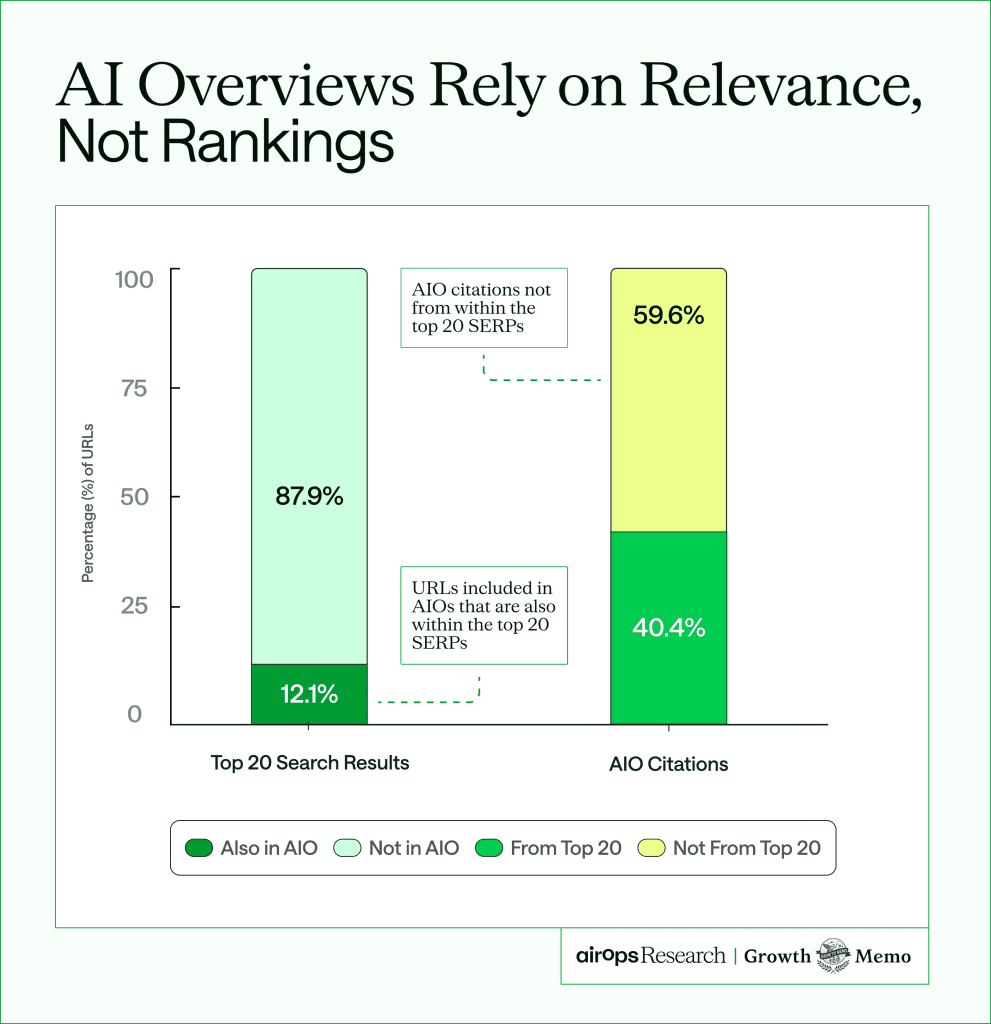
Table of Contents
What is AI Visibility
AI visibility is the frequency and prominence with which your brand, products, insights, and other site content appear within AI-generated responses.
Being on the first page isn’t enough to appear in AI-generated responses. You have to be the reason the AI gave the answer it did. AI-powered features now appear in over 57% of informational queries2, making them an important consideration if you want to remain visible to users.
How Citations in AI Work
Another aspect of a useful AI SEO guide is to understand how these citations in AI actually work. This is an important step when trying to figure out how to increase AI citations for your brand.
Rather than stacking websites in a results list, many AI systems lean on Retrieval-Augmented Generation, or RAG.
When a user asks a question:
- The AI performs a lightning-fast search for the most relevant information across the web.
- It then groups those chunks into one reply and credits the sources that best support the answer.
Frequently Asked Questions
What are the AI SEO guidelines around optimizing pages for AI visibility in 2026?
Use answer-first formatting. That means placing direct responses immediately under headlines. Prioritize semantic chunking by creating standalone modules of information and implementing advanced data schema markup to define your data clearly. Finally, focus on information gain. AI favors original data and unique insights over paraphrased content when selecting which sources to cite.
Why is AI visibility optimization becoming as important as keyword rankings?
More searches now show an AI summary at the top of the page, and that’s often where people stop reading. If your brand isn’t part of that first answer, a good keyword ranking further down matters less than it used to. AI SEO guides and optimization strategies are about protecting that “answer layer,” so you’re visible even when users never scroll.
How will I know that this AI visibility or GEO guide works?
Success is measured through citation share and brand mention velocity. While using these strategies, use tools like SEMRush AI visibility toolkit to track your “share of voice” within LLMs. This tells you what percentage of AI responses for your category actually credit your brand.
The Value of Earning Inclusion and Attribution in AI-Generated Answers
Getting cited by AI is the 2026 equivalent of winning a featured snippet. Before diving into the AI SEO guide framework, let’s explain why attribution is your most valuable asset.
- The Implicit Endorsement Effect
When an AI like ChatGPT or Gemini pulls your data to answer a prompt, it provides an implicit endorsement of your authority. Recent studies show that about 46% of shoppers say they use AI “most or every time” when shopping3, and you can expect this number to keep growing as AI gets better.
- High-Intent Traffic (8-12% ctr)
While total search volume may be lower, the quality of traffic from AI citations is significantly higher. Data reveals that users who click a citation link have an 8% to 12% click-through rate, often bypassing the “browsing” stage and moving to “consideration”4
- Protection Against “AI Sameness”
A rarely talked about issue in many AI SEO/GEO guides is that, without attribution, your unique insights risk being absorbed into the “AI soup,” where the AI gives your answer but takes the credit. Securing a citation ensures your brand maintains its intellectual property and prevents your expertise from becoming a generic commodity.
- Direct Impact on Conversion
Being cited in a “buy” or “compare” query (e.g., “Best AI SEO tools for small businesses”) places your brand at the exact moment of decision. Brands with high AI citation frequency in these transactional queries see an increase in conversion likelihood compared to brands that only appear in traditional blue links5.
Let Coalition Technologies guide you through AI SEO optimizations. We can also help your brand show up more often in AI-generated answers.
- Define Citation Goals and High-Value Intents
Define which questions actually matter for revenue or your conversion goals. Start with the prompts real buyers use in calls, chats, demos, and searches.
Then narrow that list to the ones where a visible mention or link would realistically move someone closer to singing or purchasing. If you’re struggling with clearly defining these goals, let AI SEO / GEO experts guide you.
- Map Those Intents to Questions and URLs
Turn each intent into a specific written question, then assign it to a single product, service, or resource page.
Clean up overlaps so every important topic has one clear “home” URL and a clearly named brand or person attached to it.
- Benchmark Your Current AI and SERP Presence
Visibility in ChatGPT, AI Overviews, and other LLMs is measured by perception drift (the gap between how you describe your brand and how an LLM summarizes it).
Audit your presence by running searches across these various models to see if you’re a “Source” (cited with a link), a “Mention” (named but not linked), or invisible.
This part of AI SEO helps guide your decisions since it helps you identify which models have successfully ingested your data and which ones are hallucinating or leaning on your competitors.
- Fix Crawl, Access, and Performance Blockers
If a page is technically heavy or uses complex JavaScript for its core message, it becomes a low-confidence source for RAG systems.
You want to make sure that your robots.txt allows for LLM-specific crawlers and that your templates are lean enough for instant parsing.
Make sure everything from weak internal linking to duplicate URLs is resolved. Your page shouldn’t be painful to load if you want it to be treated as a trusted source.
- Refactor Anchor Pages into Machine-Quotable Answers
This is rarely mentioned in AI SEO/GEO guides, but it’s important too. Reshape your priority pages so the core answer sits near the top, written in clear language that doesn’t need editing.
Trim filler, tighten sections around distinct questions, and add details that aren’t already in every competing article on the same topic.
- Reinforce Trust and Authorship
Make it obvious who is speaking and why they’re credible. This means adding bylines, short bios, dates, and links to original references. Keep brand, content, product, and person names consistent across your site so models can reliably attach those labels to your page.
- Build Topical Authority Around Those Anchors
Another rarely mentioned reality of AI SEO in many guides is that citations aren’t just earned on-site. They are reinforced by the dual signal mentions and links. In 2026, we use a “Hub and Spoke” model where supporting content tackles niche objections and internal links point back to the main anchor.
This signals to the AI that you aren’t just lucky enough to have one good page. You own the entire topical cluster.
Earning mentions on high-authority, knowledge-base sites like industry wikis or top-tier news outlets provides the external validation that LLMs use to “fact-check” their own summaries.
- Measure AI Visibility and Iterate on the Weak Spots
AI visibility optimization is the non-negotiable we recommend in this AI SEO guide. Retest your core prompts monthly to see if your perception drift is narrowing.
If a competitor has replaced you in a citation carousel, analyze their content. Did they add a new stat or a clearer table? Remember that visibility here is always a moving target that requires constant refinement of the underlying data structure to stay retrievable.
Let Coalition Technologies Help You Grow AI Visibility For Your Brand
If this AI SEO guide feels like a lot to run alone, that’s exactly where the team of experts at Coalition Technologies can help. We spend our days turning several sites into clean, machine-readable sources that models can trust, cite, and keep coming back to.
We’ll help you decide where citations actually matter, restructure the key page, and set up tracking so you can see whether your work is paying off. Along the way, we’ll answer practical questions like how to increase LLM citations for your highest-value topic and how to get mentioned in ChatGPT without resorting to gimmicks or spam.
Instead of guessing what AI systems see when they hit your site, you get a repeatable GEO process backed by technical SEO, content, and analytics in one place. If you’re ready to treat AI visibility like a real channel, not a side experiment, contact us today.
Sources:
LinkedIn, Why does AI search traffic convert so much better? 2025