



The Rundown
- AI platforms drove 1.13B visits to top sites in 2025, which is a 357% YoY surge.
- ChatGPT accounts for over 80% of AI referrals.
- Google Search still dominates referrals, but traffic from AI is growing fast.
- Publishers allowing indexing see the highest AI-driven gains.
- Ecommerce, news, and reference sites are the top beneficiaries.
- AI-assisted visits last longer and generate more engagement than average.
- Hybrid search features, such as AI Overviews, are accelerating the shift from traditional search to AI-powered search
- Businesses should prepare for the long-term impact of AI-generated traffic.
A year ago, traffic from AI LLMs was unheard of. Today, it’s a tidal wave we can’t ignore. New data shows that AI platforms like ChatGPT, Google’s Gemini, and others drove 1.13 billion visits to the top 1000 websites, which is a 357% increase from the same time last year.1
What’s fueling this growth in AI traffic? In short, user behavior is evolving. People are increasingly asking AI assistants for answers, product recommendations, and content. The tools themselves are getting better at handing off users to websites for more details.
Table of Contents
AI Traffic Growth Trends
According to Adobe’s digital trends research, U.S. web traffic from AI-driven referrals increased more than tenfold from mid-2024 to early 2025. That’s a 1000%+ jump in under a year, confirming what we’ve observed firsthand: consumers are embracing AI for search and discovery en masse.
When 18% of U.S. Google users saw AI summaries in the results, they clicked through only 8% of the time, compared with 15% when no AI summary was present.
Internal analyses support this trajectory. Across a subset of CT clients, AI-driven sessions grew more than 2,300 percent year over year in June. While this looks explosive, it reflects how early we are in the AI adoption curve. A Datos analysis from earlier this year shows that big percentage swings are common at this stage because the initial baseline is so small.
The bottom line is that AI has shifted from only answering questions to directing a growing number of users to websites.
AI Vs Google
Even with this remarkable growth, let’s be clear: traffic from AI is still so small compared to Google. Google Search remains the reigning champion of referrals. When all LLMs combined drove 1.13 billion visits, Google Search delivered roughly 191 billion visits to websites.1
One industry report found that in Q2 2025, AI-driven traffic accounted for just 0.102% of all external web referrals, whereas Google accounted for over 84%.4 In other words, the growth in AI traffic, while eye-popping in rate of increase, is starting from a tiny base.
Does It Mean AI Isn’t Important?
No. Focusing only on the present share of traffic from AI misses the trajectory. AI referrals may be tiny now, but they’re growing fast, and their influence on the future of web traffic is outsized. Consider that at the start of 2025, only 1 in 200 visitors to a particular network of sites was from an AI bot. By mid-2025, it was like 1 in 50.4
Part of the AI traffic growth trend is that publishers are bracing for a “Google Zero” scenario in which search engines (or AI answers) might keep most of the traffic to themselves. We aren’t there yet, but we see Google’s share of outbound clicks slightly declining as traffic from AI and AI answers proliferates.
Google’s own data showed that its share of external referrals dropped from 90% to 84% in a year.4 AI traffic might still be the little guy, but it’s the little guy that just grew 357% and that momentum shows no signs of slowing.
Factors Driving the Growth in AI Traffic
AI Chatbots
These LLMs, such as ChatGPT, Gemini, Claude, and others, are racing to become the go-to answer engines for users. ChatGPT, in particular, has opened the floodgates of traffic from AI. It now has a plugins ecosystem and browsing capabilities that frequently cite or link out to sources.
In Similarweb’s analysis, ChatGPT accounted for more than 80% of all AI referral traffic to the top sites.1 When one platform with hundreds of millions of users decides to start including source links, this referral AI-driven traffic was bound to jump.
Better Engagement
Early on, chatbots often provided answers without pointing people to the source of the information. Now they’re more likely to include citations or suggestions to “learn more” on a website.
Users have also grown more comfortable treating AI as a starting point for research, which definitely contributes to the growth in traffic from AI. One-third of U.S. adults already use AI tools to assist everyday decisions5, which is a huge base that didn’t exist a couple of years ago.
Many of those interactions (like “what’s a good laptop under $1000”) naturally lead to clicks on AI-provided links.
AI Built Into The Search Experience
This is rarely talked about among the factors driving the growth in AI traffic, but it might not have been possible without it.
- Google has rolled out AI-generated overviews at the top of search results.
- Microsoft’s Bing integrates ChatGPT-like answers alongside links.
These hybrids are blurring the lines between traffic from AI and that coming from traditional search. We should also expect AI traffic growth trends to continue as these features roll out globally.
User Intent
AI-driven traffic continues to grow because these tools excel at complex queries like “plan my 2-week trip to Italy,” where a single source won’t suffice. The AI might give a summary and then suggest multiple websites for details on flights, hotels, and attractions.
This is why we’re bullish on AI-driven traffic: it tends to come from high-intent users who asked for something specific. We’ve observed that website visits, driven by AI traffic, spend significant time on the page.
Not just us, though. An analysis of this noted that AI-referred visits now last 41% longer and view 12% more pages on average.2
Want to take advantage of AI referrals in your business?
Frequently Asked Questions
Are brands paying to influence AI-generated referrals?
Not yet at scale, but there is growing interest. Some tools are testing monetized citations, which could blur the lines between organic traffic from AI and paid placements.
What role do plugins or third-party tools play in AI referrals?
ChatGPT plugins and browser tools can link users directly to external sites, especially for ecommerce and travel queries.
Does duplicate content hurt AI visibility, as it can with SEO?
Yes. AI models prefer original, well-structured answers. If your content matches others’ word-for-word, you’re less likely to be referenced or linked, missing out on the AI-driven traffic.
Can businesses request to be cited more often by an AI platform?
There’s no formal process yet. But sites with explicit language, FAQ schema, and trusted sources are more likely to be pulled into AI responses.
AI Traffic Growth Trends Across Industries
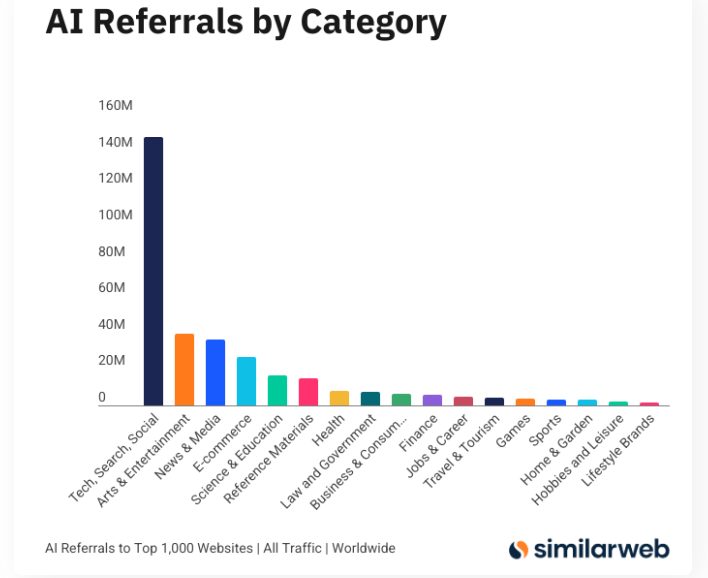
Not every industry is benefiting equally from the growth in AI traffic. Let’s talk winners and losers.
News and Media Sites
These have some of the most dramatic lifts. The data from Similarweb shows that AI referrals to news and media publishers were up a staggering 770% year-over-year.1 Why is traffic from AI so high here?
Likely because current events and general knowledge questions are popular in chat interfaces, and many news articles provide authoritative answers.
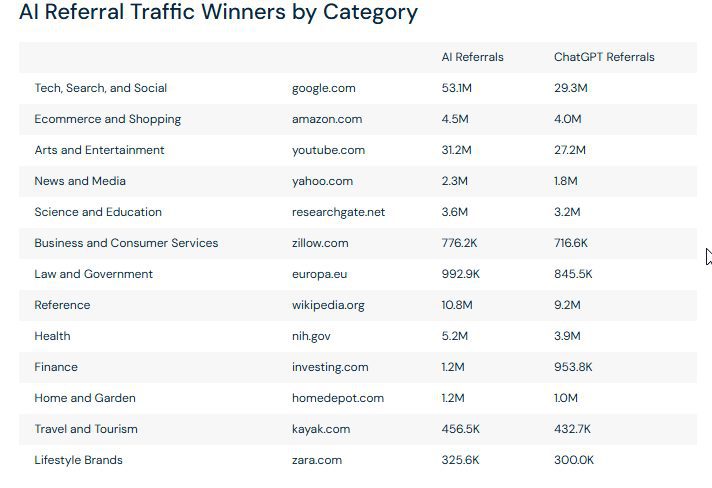
There’s also a clear pattern in these AI traffic growth trends: outlets that allow their content to be indexed tend to rank as “featured answers” in AI results, driving traffic. For example, the top news referrer from AI was Yahoo! (which also syndicates a lot of news), with 2.3 million visits, followed by publishers like Reuters and The Guardian, all receiving 1M+ from AI chats.
Ecommerce
Ecommerce brands have benefited a lot from AI traffic. As AI assistants take on the role of personal shoppers, they’re sending more users to retail sites, and for some, like ChatGPT, new AI-driven traffic features are rolling out where users don’t even have to leave the chat itself.
Amazon unsurprisingly led with about 4.5 million AI referrals, but others like Etsy and eBay saw around 1.8 – 2.0 million each.1
Other Sectors
Other sectors on the rise include tech and reference sites. Even Google’s own properties, like YouTube, benefited, with tens of millions of visits from various AI tools.1 Yes, traffic from AI is so ubiquitous that Google gets traffic from ChatGPT!
Education and How-To content is also a magnet. From Wikipedia to ResearchGate and Stack Overflow, each received millions of AI referrals. If AI can’t access the content to summarize it, it likely won’t recommend that site.
We anticipate industries like finance and healthcare, where content is often gated or sensitive, will lag in benefiting from this AI traffic growth, unless they adapt their content strategies.
Challenges With AI and the AI Traffic Growth Trends
Not all traffic from AI is welcome. Publishers have noted that while AI bots drive up scraping, the human referrals back are still minimal in many cases.4
At Coalition Technologies, we’ve seen this with some clients. A spike in bot hits from AI models “reading” the site, but only a trickle of the actual visitors clicking through or performing any meaningful action on the site.
Since this can strain resources without immediate payoff, our approach is to mitigate the negatives (through bot management and strategic content partitions) while maximizing the positives (ensuring that when an AI does draw from our content, it prominently credits and links to our site).
We’ve discussed how you can achieve this by adapting your SEO strategy for the AI era, and we are also here to help you if you need help with your AI strategy. Just schedule a call with our AI experts.
Sources
- Similarweb, “AI Referral Traffic Winners By Industry,” 2025
- Adobe, “The explosive rise of generative AI referral traffic,” 2025
- State of Search Q2 2025: Behaviors, Trends, and Clicks Across the US & Europe
- Search Engine Land, “Google sends 831x more visitors than AI systems: Report,” 2025
- Productic, “Your Users Stopped Googling Six Months Ago. Did You Notice?,” 2025