
The Rundown
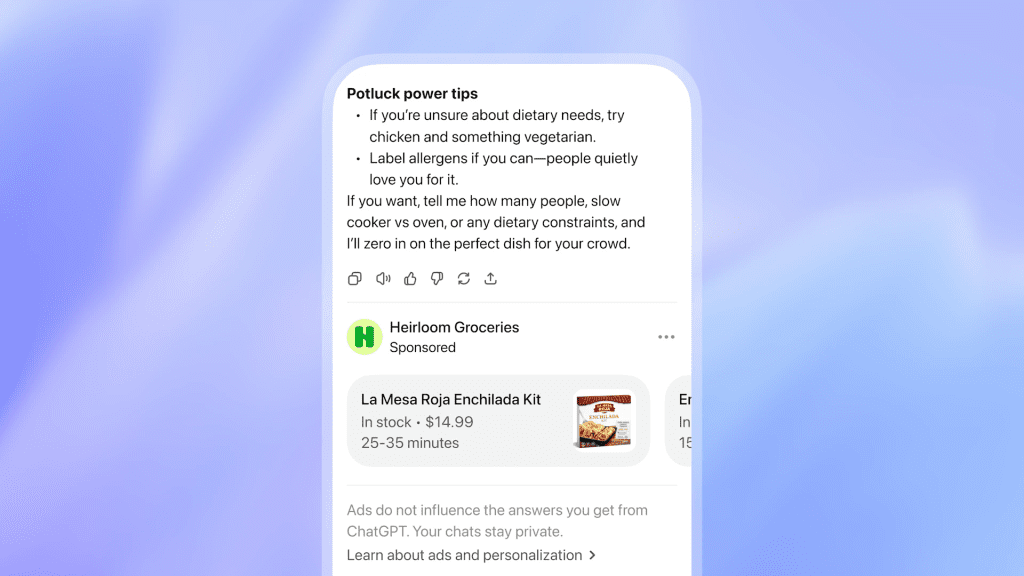
- ChatGPT Ads are sponsored cards that appear below ChatGPT responses and are labeled separately from the answer.
- OpenAI matches ads to the context and intent of a conversation, not just exact-match keywords.
- Advertisers use context hints to describe the conversations, topics, and buyer scenarios where their ads may be relevant.
- ChatGPT Ads currently support CPC and CPM buying, with self-serve campaign management available through Ads Manager Beta.
- The platform’s reporting is still limited, so advertisers need outside analytics and clean conversion tracking to judge performance.
- ChatGPT Ads should not replace Google, Meta, email, or SEO, but they may become a useful test channel for brands with strong marketing foundations.
- Businesses should approach ChatGPT Ads with a contained budget, clear measurement plan, and landing pages built around the user’s likely question.
Even as Sam Altman promised otherwise1, we always knew ChatGPT ads were coming. Now they’re here, live inside ChatGPT, with a self-serve Ads Manager that went into beta this spring.2
A lot of people now ask ChatGPT the questions they used to type into a search box.
- “What’s the best CRM for a sales team?”
- “Help me plan a four-day trip to Lisbon.”
- “I need a contractor for a bathroom remodel.”
It was just a matter of time before OpenAI opened the door for brands to pay to show up inside those conversations.
For marketers, that’s a new surface, with a new targeting model, attached to a platform with hundreds of millions of users and almost no operational track record. So let’s dig in and make an effort to understand it before any budget gets near it.
Table of Contents
- 1 The Basics
- 2 What Won’t Run on the Platform
- 3 The Account Structure
- 4 Context Hints, the New Targeting Primitive
- 5 Bidding, Tracking, and What Reporting Misses
- 6 How ChatGPT Ads Fit Alongside Google, Meta, and the Rest
- 7 What’s Changing Underneath
- 8 Frequently Asked Questions
- 9 What Businesses Should Do Right Now
- 10 Where That Leaves a Marketer in 2026
The Basics
ChatGPT ads, or OpenAI ads, are sponsored cards that show up below an answer the AI just gave. It has a headline, a short description, an image or logo, and a link to the advertiser’s site. The card is labeled “Sponsored” and sits in its own box, separate from the answer above it. OpenAI calls this “answer independence,” meaning the model gives its real response first and the ad sits underneath as a separate suggestion.3
The trigger for an ad isn’t keyword-based. OpenAI’s matching system reads the topic of the conversation itself and decides whether any advertiser’s offering fits. Someone planning a Mexican-themed dinner party might see an ad for a grocery brand, while someone troubleshooting accounting software might see one for a competing tool.
Right now, ads only appear for users on the Free and Go plans, and the geographic rollout is still in progress. The U.S. went live first, with the UK, Mexico, Japan, Brazil, and South Korea expanding next. Paying users on Plus, Pro, Business, Enterprise, and Education plans don’t see ads at all, which carves a meaningful chunk of ChatGPT’s audience out of reach for advertisers.4
What Won’t Run on the Platform
A fair amount of inventory is off-limits by design. OpenAI keeps ads away from personal health, mental health, and political topics, and they don’t appear in Temporary Chats or for users who appear to be under 18. On the advertiser side, categories like adult content, dating, alcohol and tobacco, recreational drugs, healthcare and medicine, gambling, legal services, political content, and many financial services are restricted or can’t run on the platform at all yet.5
The flip side is that the audience left over skews heavily toward people in active research and decision mode. The mindset is different from feed-scrolling on social platforms, and that’s part of what makes the channel interesting even with the constraints.
The Account Structure
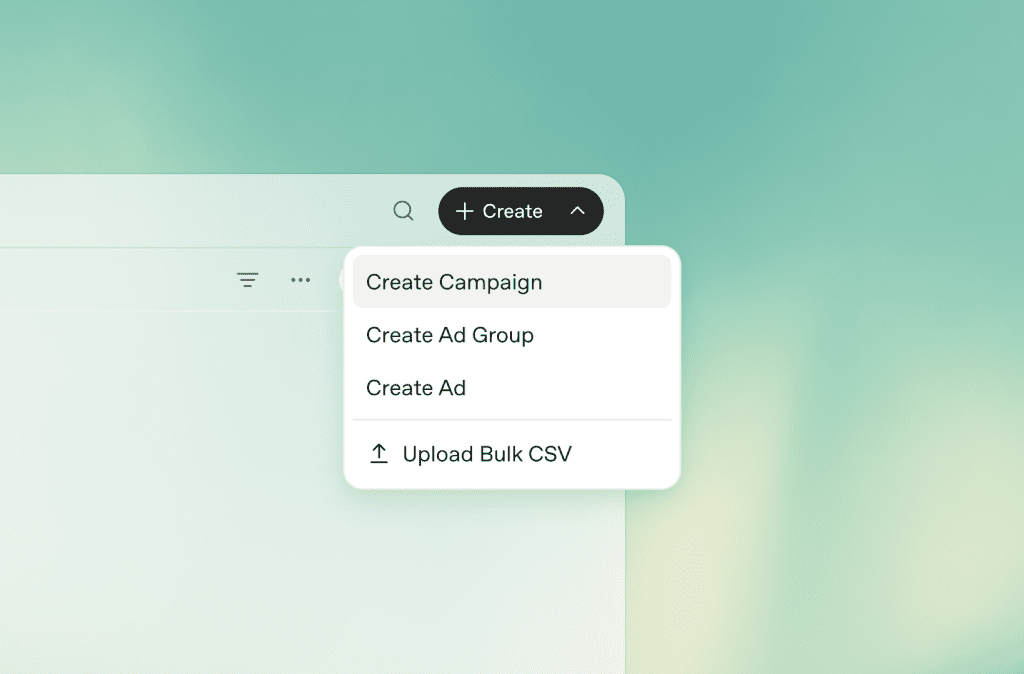
Anyone who has used Google Ads or Meta Ads Manager will recognize the skeleton of ChatGPT’s Ads Manager. The hierarchy is the familiar campaign-then-ad-group-then-ad nesting, and the platform includes a tools section, billing, conversion tracking, and a change history view that mirrors what advertisers expect from mature platforms.
At the campaign level, advertisers pick an objective (currently clicks or reach, with conversions coming), a location, a budget, and a budget type. One detail worth flagging up front: the budget type appears to be locked at campaign creation. Daily versus lifetime can’t be toggled later, which is different from how Google handles things and the kind of small detail that bites people who don’t plan for it. Targeting is also limited geographically right now, with only the United States currently supported.
Context Hints, the New Targeting Primitive
The most important difference in ChatGPT Ads happens at the ad group level. Instead of bidding on keywords, advertisers provide what OpenAI calls “context hints,” a plain-language description of the conversation, topic, or buyer scenario where the ad should be eligible to appear.
A Google Ads keyword like “ecommerce SEO agency” is a string the matcher tries to align with words a user typed. A context hint like “small business owner trying to grow ecommerce sales through search” is a description of a buyer the system tries to align with the meaning of an ongoing conversation. The matching is interpretive rather than literal, and OpenAI has been explicit that hints don’t guarantee placement.
The interface for entering hints is minimal right now. There’s one field where advertisers describe conversations, topics, and keywords all together. A more mature version of this platform would probably separate those inputs the way Meta and Google do, so for now, expressing intent clearly in a single box is part of the craft.
Bidding, Tracking, and What Reporting Misses
ChatGPT Ads supports both CPM and CPC, after launching initially with CPM only. Minimum CPC bids start at $0.01, but practical delivery requires a meaningfully higher bid. OpenAI currently recommends a starting max bid of $3 to $5 per click6, and those numbers will shift as the auction matures.
Conversion tracking runs through a pixel on the advertiser’s site plus a Conversions API for server-side measurement.7 Anyone who has worked with Meta’s event manager will find the event categories almost identical. The default attribution window is 30 days and doesn’t appear to be configurable yet. There’s also no clean way to deploy the pixel through Google Tag Manager right now, which means direct site code or developer involvement.
Reporting is where the beta status shows the most. The interface surfaces impressions, clicks, spend, CTR, average CPC, average CPM, and raw conversions. Missing are the metrics most performance teams treat as table stakes: cost per conversion, conversion rate, conversion value, and ROAS. Those have to be calculated manually for now, and segmentation is limited to device and country, with no time-of-day or day-of-week views yet.
How ChatGPT Ads Fit Alongside Google, Meta, and the Rest
Google Search Ads remain where the highest-intent commercial searches happen at scale. Meta still owns some of the most sophisticated demographic and interest-based targeting for prospecting. Shopify is still the operational backbone for an enormous share of ecommerce, and email and organic search still drive meaningful revenue for businesses that invest in them properly. None of that changes because OpenAI launched an ad product.
What ChatGPT Ads do offer is access to a different kind of moment. When someone asks ChatGPT to help them plan or compare or solve, they’re in a research posture qualitatively different from scrolling a feed or typing a short search query. Whether that context turns into measurable conversion lift at scale is still being figured out by the early advertisers, and the data on that question will be one of the more valuable assets in performance marketing over the next twelve to eighteen months.
The honest counterpoint: the platform is in beta, the addressable audience is gated, inventory is intentionally limited, reporting is thin, and early CPCs are likely to be higher than equivalent Google campaigns until the auction matures. For businesses on tight budgets that haven’t yet maxed out the platforms with proven ROI for their category, ChatGPT Ads probably shouldn’t be the first move. They might be the tenth, or the test budget at the edge of a working strategy.
Want help getting into ChatGPT Ads?
Let’s talk.
What’s Changing Underneath
A good chunk of what used to be Google searches now happens inside AI assistants. Google’s running its own AI answers, and Anthropic, Perplexity, and other players are building conversational interfaces that handle plenty of commercial queries too. Traditional search isn’t getting fully replaced anytime soon, but it’s losing share.
That has real consequences for how marketers operate. People are typing full questions now instead of three-word queries, which means landing pages and ad copy have to sound like answers to what someone actually asked. Attribution gets messier too: a user might spend three minutes talking to an AI, click one sponsored card, and convert a day later, and the credit can sit in five different places. Untangling that takes proper measurement infrastructure on the brand’s side, first-party data, server-side tracking, and an attribution model that doesn’t treat a single click as the whole story.
Brand visibility inside AI assistants is also becoming its own discipline. It shares DNA with SEO without being SEO. Brands that never come up when someone asks ChatGPT or another AI about a category are invisible in a growing share of buyer journeys, regardless of whether they’re advertising. Showing up organically and showing up as a paid placement are becoming two sides of the same coin.
Frequently Asked Questions
What Businesses Should Do Right Now
For companies with a healthy marketing program already in place, ChatGPT Ads are worth testing with a deliberate, contained budget. The platform is too young to lean on for performance, but the learnings advertisers build now will translate directly to auction and creative advantage when ChatGPT Ads scales in 2027 and beyond.
A useful test requires clean conversion tracking with pixel and ideally server-side implementation, a tight set of context hints that reflect how buyers actually talk, and landing pages that answer the user’s likely question rather than push a call to action. The measurement plan also has to compensate for the platform’s current reporting gaps using outside analytics infrastructure.
A lot of what makes this work in production sits below the surface: pixel and Conversions API implementation, context hint development, account structure decisions, bid strategy, measurement reconciliation across platforms, and the ongoing work of figuring out which conversations drive business. None of that is in the Ads Manager interface, and none of it is documented on a help page. It’s the kind of thing teams either build through expensive trial and error or bring in someone who has already done the trial and error somewhere else.
Where That Leaves a Marketer in 2026
For any marketer with skin in performance, ChatGPT Ads are worth the attention. The platform is a completely new advertising surface, with hundreds of millions of users and a different intent profile than anything that came before, but also a beta product in a category that will look very different in two years.
So take the channel seriously, but without taking the hype seriously. Get the fundamentals right on the platforms that already work, build the tracking and content infrastructure that pays off across every channel, then start learning this new surface with a contained budget and clear objectives.
Logging into ads.openai.com is the easy part. The harder work is knowing which mistakes to avoid on a new platform, how to wire it into a broader stack, and how to read thin early data without overreacting. Coalition has been running paid campaigns through every major platform shift of the last decade, which means clients testing ChatGPT Ads aren’t paying for the platform learning curve twice. If that’s the kind of partner you’d want in your corner on this one, get in touch and let’s talk about what testing ChatGPT Ads/OpenAI Ads could look like for your business.
Sources:
- https://searchengineland.com/is-chatgpt-google-search-killer-438643 ↩︎
- https://ads.openai.com/ ↩︎
- https://openai.com/index/testing-ads-in-chatgpt/ ↩︎
- https://help.openai.com/en/articles/20001047-ads-in-chatgpt ↩︎
- https://openai.com/policies/ad-policies/ ↩︎
- https://help.openai.com/en/articles/20001207-ads-in-chatgpt-the-basics ↩︎
- https://developers.openai.com/ads/conversions-api ↩︎