



The Rundown
- Google remains the foundation of search, driving nearly 90% of traffic and defining visibility for businesses.
- Bing offers a smaller reach but cheaper ad clicks and strong integration with Microsoft Copilot.
- Yahoo still matters through its finance, news, and email ecosystem, keeping a loyal base.
- DuckDuckGo and Brave highlight the privacy-first trend, which is important for industries where trust is key.
- Regional leaders like Baidu in China, Yandex in Russia, and Naver in South Korea dominate their home markets and can’t be ignored if you operate there.
- ChatGPT is one of the most recognizable names in AI search. It has both free and paid models that deliver conversational answers. It’s also increasingly being integrated into apps and other third-party tools.
- Gemini keeps Google in the conversation surrounding what the best search engines are. It’s what provides the AI Overviews in Google search results and functions as the AI assistant on Android and Google phones.
- Perplexity is growing fast thanks to its transparent citations, making it a trusted research tool.
- Copilot (Microsoft) integrates into Bing and Windows, making it unavoidable for enterprise users.
- DeepSeek is an emerging challenger that emphasizes speed and efficiency.
- Claude (Anthropic) is known for accuracy and nuanced responses, less mainstream but growing.
- Meta AI is embedded across Meta, Instagram, and WhatsApp to give a search function to those social media apps.
- BlackBox is niche, but beloved by developers for code-focused queries.
- Grok blends search with live social content, surfacing answers tied to real-time conversations.
When you think about what the best search engines in 2025 are, Google remains the undisputed leader. It drives nearly nine out of ten searches worldwide, and for businesses, it is always the first priority.
That said, smart marketers know that there’s more to this landscape of search engines. There are smaller players like Bing, which offers cost-efficient paid clicks, Yahoo, which still matters inside its finance and news ecosystem, and privacy-first engines like DuckDuckGo and Brave, which have loyal users.

What’s different in 2025’s discussion of the most popular search engines is that AI engines aren’t on the horizon anymore. It’s not just about what the best search engines are, since these language models are already shaping how results appear and which brands get cited.
ChatGPT, Gemini, Perplexity, and Copilot now sit alongside Google as daily discovery tools, meaning that businesses must plan for visibility in both traditional search and AI-generated answers.
Table of Contents
- 1 Google: The Undisputed Leader
- 2 Bing: Small Share, Big Opportunity
- 3 Yahoo: The Veteran Still Around
- 4 DuckDuckGo and Brave: Small But Symbolic
- 5 Baidu, Yandex, and Naver: Regional Powerhouses
- 6 AI Search Engines: The New Frontier
- 7 Frequently Asked Questions
- 8 Working With Coalition Technologies
- 9 Sources
Google: The Undisputed Leader
No matter how the search landscape shifts, Google is still the first and most important platform for businesses. With nearly 90% of global search share1, it defines how billions of people find answers and how companies get discovered.
Its unmatched ecosystem of Search, Maps, YouTube, Gmail, Android, and so on makes it the one engine you cannot ignore when thinking about what the best search engines are today.
For businesses, Google sets the standards for visibility. Its AI Overviews, powered by Gemini, are already changing what users see at the top of the page. That’s not a threat. It’s an opening.
Brands that structure content clearly, cite credible sources, and invest in technical SEO are being featured directly inside those AI results. On the paid side, Google Ads remains the most competitive auction, but also the one with the greatest return for high-intent traffic.
In short, if you’re deciding where to focus your resources among the most popular search engines in 2025, Google isn’t just first on the list. It is the list. The discussion of what the best search engines are should always be rooted in a strong consideration for Google.

Bing won’t rival Google in scale, but it still matters for businesses. Many users come through Windows and Edge, often professionals on desktops2 with higher purchasing power. That audience alone makes it worth paying attention to.
The real draw is advertising. With fewer competitors bidding, Bing’s ad clicks usually cost less than Google’s. You won’t see the same traffic volume, but you can capture steady conversions at a lower price. That makes it worth mentioning in the discussion around what the best search engines are today.
Microsoft Copilot also puts Bing in front of millions of office workers every day. For businesses, that means Bing is more than a backup. It’s an affordable way to reach valuable users while staying visible in AI-powered search.
Want visibility across all search engines?
Yahoo: The Veteran Still Around
Yahoo isn’t shaping the future of search, but it hasn’t disappeared from the conversation of the most popular search engines either. Its search results run on Bing’s engine, yet millions of people stay inside Yahoo every day for finance news, sports, and email.
When talking about what the best search engines are, Yahoo’s relevance in this discussion is about its ecosystem that keeps its search bar active even if it isn’t top of mind for most marketers.
For businesses, Yahoo matters less for innovation and more for audience reach. If your customers spend time checking Yahoo Finance or reading its news, your ads and search visibility here still have value.
It won’t be a primary focus, but it’s a channel worth monitoring when your audience overlaps with Yahoo’s loyal base.
DuckDuckGo and Brave: Small But Symbolic
DuckDuckGo and Brave don’t move huge traffic numbers, and they probably never will. Still, in this discussion around what the best search engines are today, these two have carved out a corner in the market by promising privacy. No tracking, no selling your data.
That message resonates with the type of user who really cares about control, which is why they are still one of the most popular search engines.
For most companies, you won’t see big returns here. But if you’re in finance, healthcare, or another trust-heavy space, showing up can matter. The volume is small, but the intent is strong, and sometimes, those clicks are worth keeping.
There is a case to be made for what the best search engines in other countries are.
Baidu with 51.45% in China, Naver at 51% in South Korea, and Yandex in Russia are also hard search engines to ignore because each of them dominates its home market. Baidu handles the vast majority of China’s web searches, and Yandex plays a similar role in Russia. In South Korea, the search engine market share is split nearly equally between Naver and Google.
These search engines are essential if your business operates primarily in those regions and shouldn’t be ignored in your considerations of what the best search engines are.
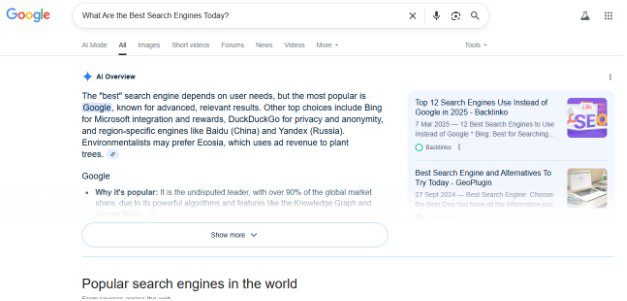
AI Search Engines: The New Frontier

AI isn’t “on the way.” It already sits between many queries and the click. The goal here isn’t to chase every tool. It’s to make your pages the ones these systems cite, summarize, and send users to.
Although these are AI models and not inherently search engines, there is a case to be made about their relevance in the discussion around the most popular search engines today. Therefore, since we are answering the question of what the best search engines for businesses are, we will discuss some of the most important ones here.
ChatGPT (OpenAI)
ChatGPT is one of the most dominant tools in the AI-powered search today for millions of people who want fast, conversational answers instead of scrolling through ten blue links3.
For businesses, the value lies in visibility through well-structured and factual content. ChatGPT tends to surface concise explanations and examples that it can trust.
That means pages with clear headings, updated data, and natural question-and-answer formats are more likely to be cited directly in its response.
As a business owner, thinking about what the best search engines for your business are, think of this tool as one where buyers, students, professionals, enthusiasts, and all sorts of people turn to compare options and plan purchases.
Gemini (Google)
Just like in traditional search, Google has significant influence in the AI-powered search space thanks to Gemini, which powers AI Overviews directly in the search results. These AI Overviews give an experience that is so valuable and influences a lot of buying intent.
For businesses, that means that ranking in search results is taken to the next level if your content is chosen for the summary box at the top of the page, and this has further cemented Google’s place as the leader in the discussion of what the best search engines are today.
It’s true that most popular search engines today now have a functionality similar to AI Overviews, but it’s still Google’s Gemini that millions of people interact with when it comes to search results every day.
Perplexity
Perplexity has grown quickly because of its transparency. It shows sources alongside its answers, and this is something that everyone, from students and professionals to decision-makers, loves.
Instead of hiding these citations, it highlights them, which means that companies that publish clear, fact-based, and updated content always have a real chance of being surfaced, since these are the things that perform best here.
In the discussions surrounding what the best search engines are, this is one of the most reliable tools for meeting research and service comparison needs for businesses.
DeepSeek
Users who love DeepSeek do so because it delivers concise answers faster than many other search engines, so they use it for quick lookups and technical queries.
For businesses, the lesson is that agility matters. This language model favors content that is short, direct, and well-structured.
While it may not yet hold the same market share as ChatGPT or Gemini, DeepSeek shows how niche AI engines are influencing the competitive set. In other words, it belongs to the list of what the best search engines are.
Claude (Anthropic)
Claude doesn’t yet match the traffic of Google or ChatGPT as well, but it’s also part of the “most popular search engines” discussion due to its reputation for safety and precision. Businesses can use it for long-form, structured content because, unlike models that prefer short snippets, Claude rewards full explanations with step-by-step logic.
Whitepapers, compliance guides, detailed FAQs, and all other forms of long-form text are more likely to be surfaced and summarized here.
Therefore, if you’re a B2B brand, for instance, with complex offerings and are wondering what the best search engines or AI models are that can work well with your business, this model is a great option.
Meta AI
Discussions around the most popular search engines in the social media space have to include Meta and its AI model, Meta AI.
Meta AI is embedded in Facebook, Instagram, and WhatsApp. So many people who use these platforms use Meta AI without even realizing it. When someone types a question into those apps, Meta AI provides instant answers.
That integration makes it part of the “what are the best search engines for businesses in 2025” conversation, especially for consumer-facing businesses.
Grok (X / Elon Musk)
Grok is to X what Meta AI is to Meta. Grok combines AI with the live, real-time data for the X platform, creating answers that reflect trending discussions.
Businesses that leverage Grok get visibility tied directly to cultural relevance. That’s why if your brand participates in industry conversations, product launches, or timely news, Grok may surface your content inside its answers. That gives companies a way to reach audiences who value immediacy over static results.
In the discussions of what the best search engines are, Grok is a reminder that authority now comes not just from evergreen content but from joining the conversation in real time.
BlackBox
For businesses like software providers and training platforms that serve technical audiences, this is the model that can help you gain influence through your published guides, repositories, and other forms of technical content that align with coding tasks. This is what makes it part of the “most popular search engines” discussion.
That’s the thing with AI. Even smaller models that serve niche audiences can have a significant influence on your business if leveraged properly. It’s not just about what the best search engines for businesses are. It’s about the best for your business.
There are several other models, with new ones that keep popping up every day, but the lesson we can take from this is that as a business owner, you should remember that it’s not just about ranking in traditional search anymore. It’s about positioning content where AI engines will find and present it.
Frequently Asked Questions
What are the best search engines for businesses in 2025?
Google remains the foundation, but Bing, Yahoo, AI engines like ChatGPT, and regional leaders all play roles depending on your audience.
Do all search engines deliver the same results?
No. Google, for instance, prioritizes authority, Bing leans on visuals and Microsoft data, while AI systems summarize based on clarity and accuracy.
What do the most popular search engines look for when ranking pages?
They measure factors like speed, structure, content quality, and so on. AI systems also value freshness and clear sourcing.
Is it important to appear in AI search results?
Yes, it is. That’s why AI models are part of the question around what the best search engines are. Being cited directly increases brand visibility before users even click through.
Should I invest more in Google or AI engines?
Google is still priority one, but allocating resources to AI visibility ensures your brand isn’t left out of the next wave of search.
Working With Coalition Technologies
You don’t have to optimize your site based on what the best search engines are. The real key is to be able to adapt your strategies quickly. Keep your strategy agile and understand where your audience is.
At Coalition Technologies, we’ve helped so many brands do just that by staying ahead of algorithm changes, PPC shifts, and AI-driven search. If you want clarity in a noisy search landscape, we’re ready to help. Reach out now and see how we can help your business grow in an ever-changing digital environment.