The Rundown
- Google I/O 2026 SEO takeaways showed Google moving Search further into AI Mode, AI Overviews, information agents, and agentic commerce.
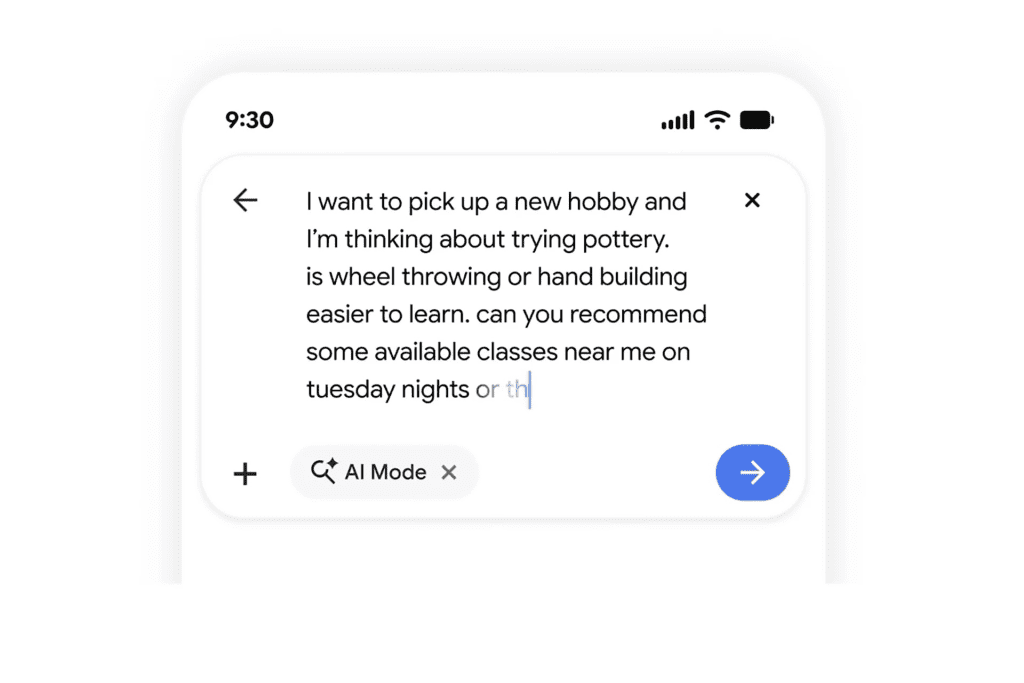
- Google’s new AI-powered Search box supports longer queries, follow-up questions, and inputs across text, images, files, videos, and Chrome tabs.
- Voice interactions are becoming more important across Google Search, Gemini, Gmail, Docs, and other Workspace tools.
- SEO strategy needs to move beyond short keyword queries and account for conversational, multimodal, and prompt-based discovery.
- Websites still matter, but they increasingly need to function as structured data sources for Google, AI systems, product feeds, and brand validation.
- Universal Cart and UCP point toward a future where Google can influence product discovery, cart decisions, checkout, and post-click customer ownership.
- AI-driven search and commerce will make attribution, conversion tracking, customer visibility, and reporting harder for marketers.
- Google I/O 2026 also featured Gemini 3.5 Flash, intelligent eyewear with real-time translation and object identification, and Gemini Omni advancing robotics and immersive experiences.
- Brands that prioritize structured content, clean product data, first-party customer relationships, editorial quality, and measurable retention paths are better positioned for AI-driven search.
Google’s annual I/O conference started in Mountain View on May 19, 20261, and if you work in search, whether as an SEO, a digital marketer, or a brand trying to get found, there’s quite a lot to process.
The biggest takeaway is not subtle, but it’s also not a surprise: Google is trying to push users into a more AI-driven, agentic search experience.
The announcements touched on nearly every part of how people find and buy things online, from how search itself is evolving to how e-commerce transactions will work. One of the more telling signals of where Google sees this heading was the emphasis placed on voice. It came up early and often, and it connects directly to the broader agentic vision Google is building toward.
Table of Contents
- 1 Voice is back, whether we like it or not
- 2 Search is AI, AI is search
- 3 The webless web is coming
- 4 Your customer relationship is at risk
- 5 Universal Cart and the new ecommerce frontier
- 6 The data problem that nobody is addressing
- 7 The slop reckoning is coming
- 8 Frequently Asked Questions
- 9 Where does this leave us?
Voice is back, whether we like it or not
Google placed a significant emphasis on voice interactions throughout the keynote. Voice search was a major SEO talking point several years back, and these announcements are going to revive those conversations.
Talking to a device is not something everyone enjoys. Speech-to-text is still frustrating on desktop and mobile and there are real concerns about how inputs get interpreted by the AIs running behind the scenes. Plus, talking out loud in an office setting, with background noise and the general weirdness of narrating queries while colleagues overhear, is just awkward.
That said, Google clearly believes there is significant value in using voice for search and AI interactions, and highlighted various use cases to make that point. They are not wrong that adoption will happen. Using ChatGPT or Gemini in the car is genuinely useful, for instance.
Voice search will be popular in SEO for a while, even if actual user adoption for voice interactions with AI remains an open question.
But the more interesting angle is voice as a collaborative tool. One of the best potential AI use cases is being added into group collaboration, working alongside human team members as perhaps a more junior team member. You can imagine three, four, or five people discussing how to approach a problem, reaching consensus, and AI listening along the way, not only taking notes and transcribing, but beginning to execute some of that work.
As a Google Workspace organization that relies heavily on Google Meet, that possibility is genuinely exciting. Imagine meeting with senior leadership to discuss SEO strategy in light of everything announced today, while Gemini quietly edits training documents and client communication templates in the background. That was not exactly demonstrated today, but you can see how voice input into one Google Suite item can become voice input into another. Given everything Google said about agents, that capability feels like a matter of when, not if.
Search is AI, AI is search
Expect to see AI become search, or search become AI, whichever framing you prefer. It makes a lot of sense that users would eventually move into a single Google AI experience used not only for “create something” or “write something” but also for “buy this product,” “find the best service,” and “compare these options.”
At Coalition, we’ve been talking about how AI and traditional search will sort of mash up into one AI-powered experience, and we saw a lot of indicators of that today. That there’s going to be a new search experience that pushes users into AI Overviews or AI Mode, along with a new “information agent” concept that can continuously scan the web, monitor changes, synthesize updates, and surface action options.
At one point during the presentation, Liz Reid, who leads Search at Google, literally said “Google Search is AI Search”.2
The search box itself has also changed3. It now expands to handle longer, more complex queries, accepts text, images, files, videos, and open Chrome tabs, and offers AI-powered suggestions that go well beyond traditional autocomplete. It is being framed as the biggest change to the Google search box in 25 years, and for SEOs it signals something important: optimizing for short keyword queries is increasingly beside the point.
The challenge for SEOs is that search is splintering across so many LLMs, both Google and non-Google, that it creates a sense of being spread thin. You have to choose strategies that work across different AIs and consumer experiences, which means budgets stretch less far and SEOs must optimize more content, pages, links, citations, and code to rank in prompt-response environments.
The unification of AI and search may benefit competent SEOs, but it also creates a real challenge as the field moves into a largely post-website world.
The webless web is coming
One of the biggest shifts for SEOs to be thinking about right now is the role of the website itself. At Coalition, another thing we have been talking about for a while now is “the webless web”. The idea is that we move from this open web, where anyone can have a website, anyone can produce content, and anyone can be found, to a place where, frankly, most people probably will not see the value in having a website and most people will not be found because of how AIs operate as intermediaries.
That dynamic may be somewhat softened if Google wins this AI-and-search arms race, because Google is considerably better at crawling and indexing larger corners of the web than its competitors. But the reality is: once you have an AI that grabs your content, relays your content, and even offers functionality like purchases and hiring interactions at the bottom of the funnel, your website becomes sort of irrelevant.
You have to be thinking about your website as a feed. How do you make it a powerful, structured data source for Google and other LLMs that will benefit their representation of your brand, product, or service?
Make your website ready for AI-driven discovery.
Your customer relationship is at risk
There’s also another question that matters more than it might seem. How do you make your website valuable enough that if someone actually lands there you can capture and retain them as a customer? Because Google’s ambition here is not limited to search.
With Universal Cart spanning Search, Gemini, YouTube, and Gmail, and agents gaining the ability to make purchases and monitor activity across all of those surfaces, Google is building toward owning as much of the discovery-to-purchase funnel as possible. SEO, paid media, YouTube, shopping feeds, and conversion strategy need to be treated as one connected system, not separate workstreams.
There is also a privacy wrinkle here that will frustrate brands significantly. As AI companies act as intermediaries, expect that, under the guise of privacy, many of these platforms will increasingly obfuscate who your customer actually is. They will retain that data for themselves and decide who has access to it. The answer will probably be: advertisers. Brands that rely on their website to gather customer information for follow-up marketing or post-sale service are going to find that relationship increasingly mediated and monetized by Google.
So the strategic push right now is around two things: making your website more feed-like, and making it more valuable from a customer retention standpoint. If AI delivers someone to your door via a purchase flow, a hire, or a deep-funnel chat experience, how do you turn that handoff into a lifetime customer relationship? Brands that crack that problem are probably going to see the most success going forward.
Universal Cart and the new ecommerce frontier
Google also talked quite a bit about UCP, or Universal Commerce Protocol4, its effort to create a unified language allowing AIs to communicate with e-commerce stores across broad swaths of the web and technology stack. This was announced back in January, and it is notable that Microsoft Copilot has also opted in. A significant number of retailers are already publishing feeds for UCP.
Today, Google demonstrated a universal cart: different retailers opted into UCP can publish their items in a way that allows Google to compile a single cart from multiple retailers.
But the detail that should get retailers’ attention is the AI commentary layer on top of the cart. The AI might flag that a particular item does not go well with another item you have selected. That is a genuinely interesting use case and a genuinely alarming one. You now not only have to think about how to get a customer to add something to the cart. You also have to contend with an AI that might comment on the items in the cart and steer the purchase in a direction you did not plan for. You could lose a sale even after the item made it into the cart, and you may not even know it, given the analytics available today.
The data problem that nobody is addressing
If there is one thing that will frustrate marketers most coming out of I/O, it is the near-total lack of transparency and data around what is actually happening behind the scenes to get a customer to see your brand or your product.
LLMs are already expensive to run. Running reporting on top of these LLM experiences will be even trickier. There is not much visibility into how prompt chains ultimately relate to a particular product being recommended or not recommended. Robust data on the actual user journey will not be available. The field is going to be reliant on Google to say where a conversion is coming from, where an interaction is coming from, without the kind of tracking we are used to: conversion funnels, user flows, heat maps, click behavior. It is reasonable to doubt that Google will offer that level of data. The result is that we all get a little lost in what you might fairly call a muddy AI soup.
That is not a comfortable place for performance marketers to be. It is the kind of opacity that breeds frustration and budget arguments. It also intersects with a related issue that is going to grow: content authenticity.
The slop reckoning is coming
AI-generated content is becoming easier to produce and easier to scrutinize at the same time, and Google is clearly building the infrastructure to act on that: SynthID and C2PA detection are expanding across Search, Lens, AI Mode, Circle to Search, and eventually Chrome, and that is not happening by accident.5
We have been saying for a while now that it was only a matter of time before AI systems, not just Google but ChatGPT, Claude, and others, started penalizing low-quality, mass-produced AI content the same way Google went after black hat SEO tactics.
Flooding the web with AI slop to game the system was never a sustainable strategy, and what Google announced today is part of the infrastructure being built to identify and discount it. Brands that have been using AI indiscriminately, without oversight, review workflows, or any real editorial judgment, are going to feel that. The ones that will hold up are the ones that have been using AI as a tool inside a thoughtful process, not as a replacement for one. Getting ahead of that distinction now, and being clear with clients about where Coalition stands on it, is probably the most valuable thing an SEO or digital marketing team can do in the second half of 2026.
Frequently Asked Questions
Where does this leave us?
The agentic era is genuinely here. Google made that clear. The question now is whether your brand’s digital presence is built to feed AI systems, survive having an intermediary inserted between you and your customer, and still turn that attenuated relationship into a loyal, valuable one. That’s a tall order. But it’s the order.
And we just scratched the surface of everything Google showed off. Gemini 3.5 Flash delivered strong results on speed and performance benchmarks and is now powering AI Overviews and the overhauled search box, including new capabilities like YouTube summarization and code assistance. Then there is the hardware side: intelligent eyewear that layers real-time translation, object identification, and contextual hints into your physical environment, and Gemini Omni pushing into robotics training and immersive, game-like experiences. The vision Google is sketching out is one where AI does not just answer your questions or shop for you, it participates in the world alongside you. Whether that lands as exciting or unsettling probably depends on how much you trust Google with your data, and if the last decade is any guide, that trust will be tested.
For now though, navigating this shift requires rethinking a lot of what has worked in SEO and digital marketing up to this point: how your website is structured, how your product data is published, how you measure success, and how you retain customers in a world where Google increasingly owns the first interaction. If you are not sure where to start, or want to pressure-test your current strategy against where search is heading, Coalition Technologies can help. Reach out and let’s figure it out together.
Sources:
- https://io.google/2026/ ↩︎
- https://www.reuters.com/business/google-expected-court-coders-consumers-io-conference-2026-05-19/ ↩︎
- https://blog.google/products-and-platforms/products/search/search-io-2026/ ↩︎
- https://blog.google/products-and-platforms/products/shopping/google-shopping-cart/ ↩︎
- https://blog.google/innovation-and-ai/products/identifying-ai-generated-media-online/ ↩︎