


The Rundown
- Local digital marketing combines SEO, AI SEO, paid ads, social, email, and CRO to drive measurable revenue from nearby customers
- Local growth depends on multi-channel visibility, customers move between search, ads, social, and website before converting
- Local SEO builds long-term visibility in search and maps, while paid ads capture immediate, high-intent demand
- AI SEO extends local visibility into AI-generated answers, using the same foundation as traditional SEO
- Social media supports trust and validation, helping prospects evaluate a business before contacting it
- Email marketing increases repeat business and reduces reliance on paid acquisition
- Conversion rate optimization ensures traffic from all channels turns into calls, leads, and purchases
- Strong local strategies connect channels into one system instead of managing them separately
- Performance should be measured by leads, calls, purchases, CAC, and ROAS, not just rankings or traffic
- Local strategies must adapt to market conditions such as competition, geography, and audience behavior
- Businesses should evaluate agencies based on their ability to drive measurable outcomes across multiple channels
Local digital marketing is the use of digital channels to help a business attract nearby customers, turn that attention into revenue, and bring those customers back later. It includes local SEO, but it goes further than that. Local digital marketing is a connected strategy built around how people find, evaluate, and choose businesses in their area.
Local competition rarely gets decided in one place. Someone may find a business on Google, see a paid ad later, check its social media, visit the website, leave, then come back a few days later through email or a retargeting ad. That is a pretty normal path now. So the goal is not to show up once and hope that was enough. The goal is to stay visible and persuasive across the whole local decision process.1
A strong local digital marketing strategy connects multiple channels to generate leads, convert demand, and drive repeat revenue in a specific market.
Table of Contents
- 1 What Local Digital Marketing Includes
- 2 Why Local Businesses Need More Than One Channel
- 3 Paid Advertising in Local Markets
- 4 Email Marketing and Local Retention
- 5 Social Media as a Trust Signal
- 6 Local SEO, AI SEO, and Modern Local Discovery
- 7 How Local Channels Work Together
- 8 FAQs
- 9 Why Local Strategy Should Change by Market
- 10 What to Look for in a Local Digital Marketing Agency
What Local Digital Marketing Includes
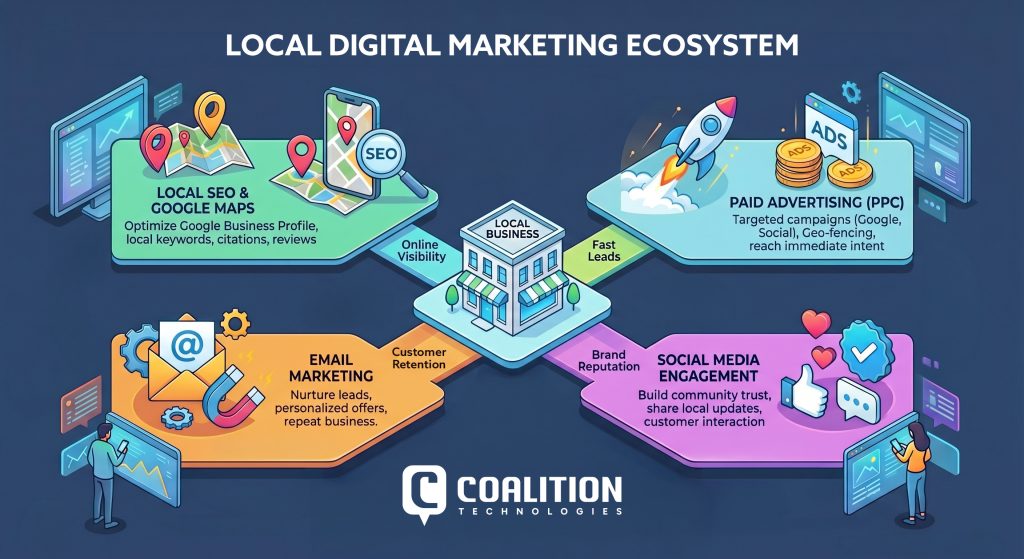
Local digital marketing includes the channels that help businesses get found, build trust, convert interest, and keep customers engaged after the first visit or purchase.
It includes:
- Local SEO
- AI SEO / GEO
- Paid advertising, including Google Ads and paid social
- Email marketing
- Organic social media marketing
- Website and CRO (conversion rate optimization) work
That mix is important because these channels do different jobs. Some help businesses get discovered. Some help close the sale. Others help retain customers and increase lifetime value. Strong local marketing connects them instead of treating them as isolated tactics.
Why Local Businesses Need More Than One Channel
Local intent is often strong. People searching for a nearby service, a provider in a specific city, or a business near them are often fairly close to taking action. 47% of users take a follow-up action within one hour of a smartphone search.2 Still, one strong ranking does not cover the whole decision process.
People compare quickly. They move between Google results, ads, reviews, websites, and social profiles in a short span of time. A business can show up in search and still lose the lead because the site feels thin, the brand looks inactive on social, or a competitor keeps showing up while that first business disappears after the click.
This is why local digital marketing should be viewed as a multi-channel system. Local SEO remains a core part of that system, especially for Google’s organic results and map-based discovery, but it is only one part.3 Paid media helps maintain presence in competitive search environments. Social media helps reinforce trust and familiarity. Email helps reduce reliance on constant reacquisition. Website and conversion optimization make all the other channels work harder.
For example, Casa Teresa combined local SEO, AI SEO, and social media as part of the same effort to grow direct visibility and bookings.
Paid Advertising in Local Markets
Paid advertising is part of local visibility. For many businesses, it is a clear way to stay in front of people who are already searching and comparing options before making a decision.
That often means Google Search Ads, Local Service Ads, Meta campaigns for awareness and retargeting, and other paid social campaigns aimed at specific audiences or service areas. Google Ads is especially useful when someone already knows what they need and is searching with real intent. Paid social usually does a different job. It keeps the brand in view and builds familiarity over time, while bringing back people who visited the site without converting.
One of the advantages here is control. A business can target by city, ZIP code, neighborhood, or service radius, then move budget based on what is actually working. That matters because local demand is not spread evenly across a market. One part of a city may respond much better to one service, one offer, or one message than another.
Paid media also gets framed too narrowly sometimes. People talk about it like it is the quick version of SEO. That misses the point. In a lot of local markets, paid media is simply part of staying visible where competition is tighter and attention is harder to hold. Organic search still matters. A lot. Paid search matters too. Same with paid social when it is used well. And retargeting matters because many local customers do not convert on the first visit. They compare, they wait, they come back.
Email Marketing and Local Retention
A lot of local marketing content focuses almost entirely on acquisition. That leaves out one of the most practical realities for local businesses. When acquisition becomes more expensive and more fragmented, retention becomes more valuable.
That is why email marketing belongs in any serious discussion of local digital marketing. It gives businesses a direct way to stay top of mind and reconnect with past and interested customers through seasonal offers.
For local businesses, repeat business is often one of the clearest paths to steadier revenue. A restaurant wants diners to return. A clinic wants patients to come back. A retailer wants past buyers to buy again. A service business wants old leads and former clients to remember the brand when the need comes up again.
Effective local email marketing usually includes welcome sequences, follow-up emails, re-engagement campaigns, seasonal promotions, and segmentation based on behavior, purchase history, or location. Nothing fancy about that on its own. It is just useful follow-up, done well and done consistently.
And that is really the point. Email reduces the need to be rediscovered from scratch every single time. It gives the business a channel it owns, one that is not tied to a ranking shift or a daily ad auction. In Coalition’s work with Iron Planet Hobbies, 47% of revenue came from campaigns and 53% from flows.
Social Media as a Trust Signal
Social media should not be reduced to posting for awareness. In local markets, it supports both discovery and validation.
Discovery matters because social platforms can surface local or location-relevant content to people who do not already follow a business. Validation matters because people often check a company’s social presence before reaching out. They want to see whether the business looks active, legitimate, professional, and credible. That means social media plays a role in the evaluation process, not just the reach process.
This is where a lot of businesses get it wrong. Random posting is not a strategy. The stronger approach is to use social media to reinforce trust by showing real work, useful content, customer relevance, and consistency over time. For some brands that may mean Instagram and Facebook. For others it may include TikTok for local discovery or LinkedIn for B2B visibility in a specific market. The platform mix depends on the audience, but the larger point stays the same. Social media helps people feel better about choosing the business.4
It also works better when it is tied to the rest of the marketing. Organic social can support paid campaigns. Paid social can retarget site visitors. A prospect may first find the business through search, then check its social profiles, then come back later through an ad or a direct visit. That still counts. It all counts.
Local SEO, AI SEO, and Modern Local Discovery
Local SEO for physical retail stores and other kinds of businesses is still one of the main pieces of local digital marketing. It helps businesses appear in Google’s organic results and map-based results when people search for nearby services, products, or providers. That includes Google Business Profile work, local rankings, reviews, citations, and location-specific pages.
That has not gone away. It still matters a lot.
What has changed is the range of places where local discovery can happen. Businesses may now show up in AI-generated answers, summaries, and recommendation-style results too. Some people call that GEO, but at Coalition Technologies we prefer the term AI SEO because it keeps the connection to traditional SEO clear.
That wording matters because AI visibility should not be treated like a separate category that floats off on its own. It grows out of the same basic work: clear content, strong intent match, useful service pages, and strong brand, service, and location association. Good local SEO supports good AI SEO. That is the cleaner way to think about it.
And locally, this matters more than some people assume. People are already using AI tools and AI-generated search features to compare providers, look for nearby recommendations, and narrow down options. Businesses that already make it easy for search engines and AI systems to understand who they are, where they work, and what they offer have a better chance of showing up there too.
Need support building a local digital marketing strategy that actually converts?
How Local Channels Work Together
The best local digital marketing strategies work because the channels support each other. Paid advertising captures immediate demand. SEO builds long-term visibility. Social media helps people trust the brand. Email brings customers back. The website turns attention into something measurable.
That is why local growth should not be judged by one ranking or one channel. A business can rank well and still underperform if the site does not convert, if paid coverage is weak in a competitive market, if social media looks inactive, or if there is no follow-up after the first visit or purchase.
This is the part people sometimes know, at least in theory, and still ignore in practice. They treat each channel like a separate project. It is not separate from the customer’s point of view. The customer sees one business and one decision. They do not care which internal bucket the marketing came from. They just compare what is in front of them. So the channels need to work together like parts of the same system. Otherwise the weak spots start showing.
FAQs
Why Local Strategy Should Change by Market
A real local strategy should reflect the market it is trying to win. It should not read like generic marketing copy with a city name dropped in.
A business in Los Angeles may need to think about sprawl, neighborhood differences, and wide service-area targeting. A business in New York City may be dealing with denser competition and different behavior across boroughs. A business in Miami may need to account for multilingual audiences, seasonal demand, and different search habits.5 Smaller regional markets have their own patterns too.
That is one of the bigger problems with generic local marketing advice. “Local” does not just mean putting a place name on a page. It means adjusting the strategy to the actual market, including competition, geography, language, audience behavior, and how different channels perform there. That is also why city-specific digital marketing pages can work well when they are built around real market differences instead of recycled copy.
Industry also changes the local plan. A home services company may need map visibility and service-area lead generation, while a law firm or real estate agency may need stronger city-specific trust signals, reviews, and lead capture. Construction and engineering firms, car rental and transportation providers, gardening and landscaping companies, and hospitality and travel businesses also need strategies built around how customers compare local providers before contacting, booking, or buying.
What to Look for in a Local Digital Marketing Agency
Businesses choosing a local digital marketing agency should look beyond rankings and traffic. The more useful question is whether the agency understands how local visibility turns into real business outcomes across multiple channels.
That means looking for measurable reporting tied to leads, revenue, and repeat business. It also means looking for an agency that can manage multiple channels effectively, since local growth depends on combined efforts. A strong agency should understand how key channels like local SEO, paid advertising, and conversion strategy work together.
It is also worth being cautious of agencies that confuse content volume with strategy. Publishing quickly can create short-term activity that does not last. A more deliberate approach usually focuses on useful content and clear structure that match local needs.Coalition Technologies helps businesses build local digital marketing strategies tied to measurable growth across the full decision process. If your business needs a more effective local strategy, contact us to schedule a consultation.
Sources:
- https://business.google.com/us/think/consumer-insights/new-consumer-decision-making-process/ ↩︎
- https://www.thinkwithgoogle.com/_qs/documents/2915/Google_Local_Search_Behavior_UK_2015_1.pdf ↩︎
- https://support.google.com/business/answer/2721884 ↩︎
- https://www.pewresearch.org/internet/2025/11/20/americans-social-media-use-2025/ ↩︎
- https://www.census.gov/quickfacts/fact/table/miamidadecountyflorida/PST045224 ↩︎