The Rundown
- At Google I/O 2026, Google made AI Mode the non-optional default in search, leading to backlash from many users.
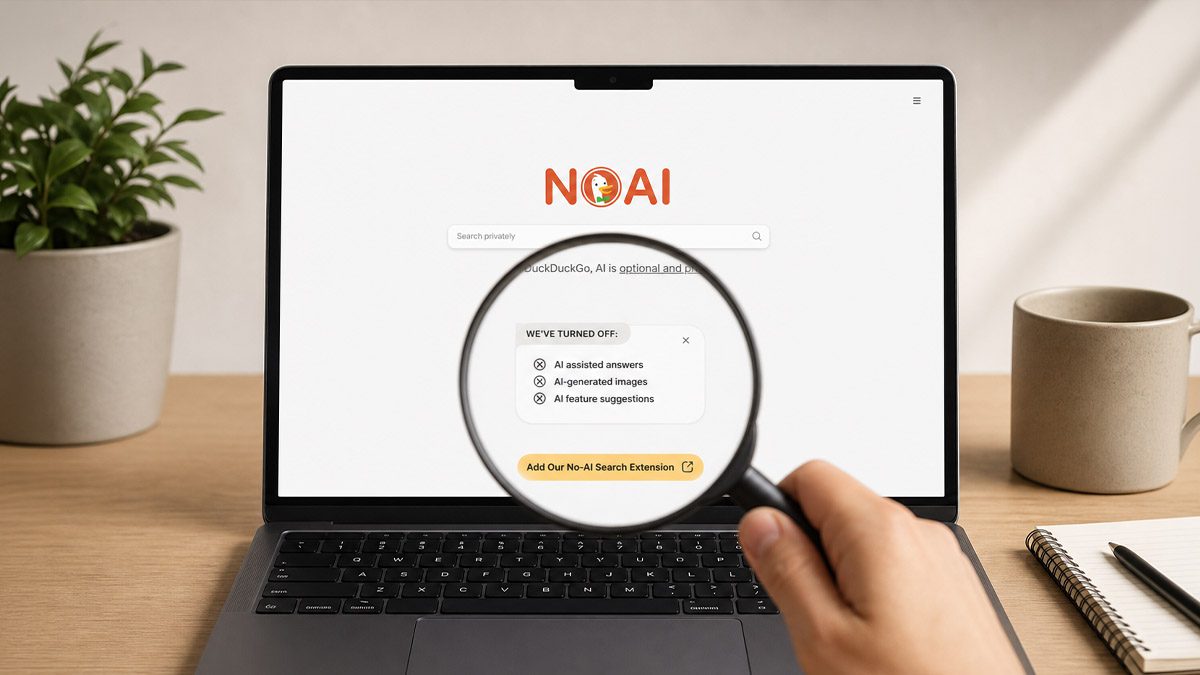
- DuckDuckGo launched a no-AI search page, then Chrome and Firefox extensions, driving a sharp rise in usage and app downloads in mid-2026.
- DuckDuckGo was founded in 2008 positioning itself as a less cluttered search engine, then pivoted to a privacy focus in 2010.
- The 2013 Snowden leaks, Apple’s 2014 Safari integration, and the 2018 Cambridge Analytica scandal drove repeated growth, peaking near 2.42% US market share in 2021.
- Growth then stalled, capped by Google paying to remain the default search engine across browsers and devices, plus a 2022 DuckDuckGo Microsoft-tracker controversy.
- DuckDuckGo isn’t anti-AI; it launched DuckAssist (2023) and Duck.ai (2024) before leaning into anti-AI positioning in 2026.
- Ranking in DuckDuckGo matters because some search users still prefer traditional results, but demand for traditional, non-AI search is durable regardless of which platform serves it.
- AI isn’t fully replacing traditional search, so brands should stay visible in both AI answers and regular results.
DuckDuckGo holds roughly 2% of US search. On paper, that’s a number you round down to zero and stop thinking about. Why would you care about DuckDuckGo SEO? But something shifted in the middle of 2026 that makes a tiny search engine worth a marketer’s attention again.
A search engine almost nobody bets their marketing on suddenly became the obvious exit for frustrated users. Google made AI the default in search, the many people who didn’t want it went looking for somewhere else, and DuckDuckGo capitalized on that wave of anti-AI sentiment and saw a big boost in usage.
For everyone who keeps saying traditional search is dying, this came as a surprise. To us, it’s just a reminder not to put all your eggs in one basket, even a basket as big as Google.
Table of Contents
What Happened to DuckDuckGo in May 2026
Just like we’ve been predicting for a while, at Google I/O 2026 Google made AI its default search experience. The company officially replaced the classic search bar with a fully interactive, multimodal AI Mode dashboard.
This goes well beyond AI Overviews, the short AI-generated summaries that have sat on top of ordinary web links since Google rolled them out two years ago. Right from the main search bar, users can now type complex multi-sentence requests, upload video or PDFs, set up 24/7 tracking agents, and even generate custom mini-apps and charts.
Google called it the biggest change to the search box in more than 25 years, and for once the superlative is pretty accurate. But there lies the issue for some: it wasn’t optional. And so, a massive wave of public backlash erupted.
Many went looking for an exit, and DuckDuckGo moved to provide it.
DuckDuckGo already had a dedicated no-AI search page, noai.duckduckgo.com, which had been introduced earlier in 2026 alongside a public Yes AI / No AI poll and a matching yesai.duckduckgo.com page. But after Google’s AI-heavy Search announcements, that page suddenly had a much clearer purpose: it gave frustrated users a simple way back to plain links instead of AI answers.
It worked. After the move, DuckDuckGo reported that US app installs jumped, averaging about 18% week-over-week between May 20 and 25 and peaking around 30% on May 25, with iPhone installs running hotter still1. Traffic to the no-AI page climbed too, and the company says the growth held for six straight days, including over a Memorial Day weekend when traffic usually dips. On June 1 it followed up with no-AI extensions for Chrome and Firefox that set the AI-free page as your default in one click.
So does that mean DuckDuckGo is anti-AI? Not quite.
The History of DuckDuckGo
The early days
DuckDuckGo was founded by Gabriel Weinberg in 2008 in Valley Forge, Pennsylvania, at a time when Google Search was starting to move beyond the old “ten blue links” format2.
Universal Search was launched by Google in 20073, blending traditional web results with images, videos, news, maps, and local listings. That made search more useful in some cases, but also more crowded.
DuckDuckGo’s original pitch was a cleaner search experience, with less SEO spam and fewer distractions than the increasingly layered results pages people were getting from Google and the other major search engines of the time, like Yahoo! and Microsoft Live Search, which would later become Bing.
But the concept didn’t really catch on. DuckDuckGo crossed 1 million searches per day in early 2012 and ran somewhere around 1 to 1.5 million through that year. That was a real milestone for a startup, but it came out to no more than roughly 0.01% to 0.02% of a US search market Google obviously dominated.
The privacy pivot and the rise
The first taste of mainstream growth didn’t arrive until the Edward Snowden leaks of 20134. DuckDuckGo had committed to not tracking its users back in 2010, years before Snowden was a name anyone knew, and it had been advertising itself that way with a “Google tracks you, we don’t” billboard in San Francisco5.
When the former NSA contractor leaked highly classified documents revealing the existence of massive surveillance programs conducted by the United States and its international intelligence allies, the “anti-tracking” idea quickly went from a niche tech preoccupation into a mainstream consumer demand. Seemingly overnight, DuckDuckGo’s daily traffic nearly doubled, and it would climb past 4 million queries within the year. Recognizing the shift in public sentiment, Apple integrated DuckDuckGo into Safari as a built-in search option in 20146, with Mozilla adding it to Firefox soon after. Together, those rollouts exposed the engine to tens of millions of new users and pushed its traffic to a rolling average of roughly 7 million daily searches by 20157.
A second wave came in 2018 with the Facebook and Cambridge Analytica scandal8, a massive data breach in which a political consulting firm improperly harvested the personal data of millions of users without their consent, which sent another round of privacy-spooked users looking for an alternative and made DuckDuckGo the obvious one.
By the time the 2020 pandemic drove overall internet use up, DuckDuckGo’s traffic climbed with it, and the company crossed 100 million daily searches for the first time in early 2021. DuckDuckGo’s US share climbed past 1% and peaked around 2.42% in 20219.
For most of a decade, the line on the graph had only gone up, and at the time there was no reason to think that would change.
Protect visibility with SEO for DuckDuckGo and other traditional search engines.
The monopoly ceiling and the fall
DuckDuckGo eventually ran into Google’s dominance and growth stalled.
Google had multibillion-dollar deals keeping its search engine as the default across major browsers and mobile devices, making it hard for competitors to change user behavior at scale. So DuckDuckGo’s US market share flattened around 2%.
Privacy had created demand, but it was not enough to overcome Google’s distribution advantage.
Then came another hit. In 2022, DuckDuckGo faced its first major public relations crisis. A security researcher found that its mobile browser blocked Google and Facebook trackers, but still allowed some Microsoft third-party trackers on sites like LinkedIn and Bing. Weinberg said the exception was required under DuckDuckGo’s search agreement with Microsoft, and the company later changed the deal so it could block those scripts too.
Still, the backlash did damage. DuckDuckGo had built its identity around a clean privacy promise, and the Microsoft exception made that promise look more complicated than the marketing suggested. It also exposed a structural weakness independent search engines rarely like to discuss. Many of them still depend on the same tech giants they’re supposedly competing against.
After that, DuckDuckGo fell below 100 million daily searches through 2022, then settled into a long flat line. For years, it hovered slightly below 2% US market share.
And ChatGPT and similar tools were yet to enter that market.
Riding both sides of the AI trend
When AI search became the industry obsession, DuckDuckGo gave it a shot. Like almost every other tech company, it tried to use AI as a growth lever.
The company launched its first major AI initiative, DuckAssist, in March 202310. This tool used natural language processing to anonymously summarize Wikipedia answers right at the top of search results. In June 2024, it followed this up by launching Duck.ai (originally AI Chat), which gave users a private, proxy-masked way to chat with models like OpenAI’s ChatGPT and Anthropic’s Claude.
But the AI features didn’t produce a massive new wave of users. Overall traffic resumed its slow downward drift through late 2025.
Then Google forced AI on its users and DuckDuckGo did what it has always done best: it capitalized on the opportunity handed to it on a silver platter.
And so it became the “anti-AI search engine.”
Frequently Asked Questions
Why Ranking in DuckDuckGo Matters Now
A few million people spent one week showing that plenty of users still want plain links instead of an AI answer, and that they’ll switch tools to get them. That demand was always there, it just took Google forcing the issue for everyone to see it.
And when those people look for a product or service, if your brand doesn’t appear, you lose the sale.
But the useful lesson here barely involves DuckDuckGo. It just happened to be holding the door open when the rush started. Google could watch this same backlash and ship its own “just the links” option, and pull most of those people right back. Or some other search engine could grab the role instead. Maybe even ChatGPT or Claude – wouldn’t that be kinda funny?
The thing is: whoever ends up serving that audience, the audience itself is there. And that audience is also looking for things they need, and generating revenue for the brands that show up.
Optimizing for ChatGPT and Google AI Mode is crucial, but don’t write off traditional SEO. For one thing, GEO (generative engine optimization), or AI SEO as we prefer to call it, is nothing but a subset of standard search engine optimization. Plus, as we just saw, plenty of users still reject AI answers and prefer the plain old links, so ranking in DuckDuckGo, Bing, and other traditional search results still matters.
At Coalition Technologies, we help your brand get found wherever your customers are searching. Get in touch in touch to learn how we can build a search strategy that helps you stay visible across traditional search and AI search.
Sources:
- https://techcrunch.com/2026/05/26/duckduckgo-installs-are-up-30-as-users-reject-being-force-fed-googles-ai-search/ ↩︎
- https://en.wikipedia.org/wiki/DuckDuckGo ↩︎
- https://searchengineland.com/an-insiders-view-of-google-universal-search-12059 ↩︎
- https://www.theguardian.com/technology/2014/jan/09/anonymous-search-tool-duckduckgo-1bn-queries-2013-google ↩︎
- https://www.wired.com/2011/01/duckduckgo-google-privacy/ ↩︎
- https://www.seroundtable.com/duckduckgo-safari-18650.html ↩︎
- https://www.ghacks.net/2015/12/09/duckduckgo-startpage-and-ixquick-search-engines-are-doing-well/ ↩︎
- https://techweek.com/search-startup-duckduckgo-philadelphia/ ↩︎
- https://hothardware.com/news/duckduckgo-cracks-100m-searches-in-one-day ↩︎
- https://techcrunch.com/2023/03/08/duckassist/ ↩︎