



The Rundown
- ROI of SEO is the return generated from organic traffic compared to the cost of services.
- Formula for measuring ROI: (revenue from SEO – cost of SEO) ÷ cost of SEO x 100
- While ChatGPT’s searches are increasing, Google still dominates in daily searches.
- Ranking in AI tools still depends on traditional SEO. If your site isn’t ranking in Google, it likely won’t show up in AI-generated answers either.
- Capturing visibility in both Google and AI tools multiplies your ROI.
- Ways to boost AI visibility include structured data; bullet points, tables, and short paragraphs; natural language queries; E-E-A-T content; expert quotes; and authoritative citations.
- Meaningful results usually start to accrue between 4-9 months.
What’s the ROI of SEO? Search engine optimization can be an incredibly lucrative investment that pays for itself many times over.
Unlike paid ads, which require ongoing spending, SEO can build upon itself exponentially. High rankings lead to higher rankings. Once the faucet is on, it can keep pouring for years.
Of course, ongoing upkeep is required to keep the momentum going, but again, initial profits often end up paying for long-term SEO services.
With AI tools becoming more prominent, many companies wonder, “Does AI SEO work?” The answer is yes, but only when it builds on a strong SEO foundation. That’s because AI tools like ChatGPT, Perplexity, and other large language models pull their answers from top-ranking search results.
The ROI of AI SEO is clearest when you recognize that every Google ranking has the potential to show up twice: once in search results and again in AI-generated responses.
Table of Contents
Frequently Asked Questions
What is a good ROI of SEO?
A “good” or strong ROI from SEO means your organic revenue significantly exceeds your SEO spend. Focus on ranking high in Google and optimizing content for AI visibility to maximize dual-channel returns.
Is AI SEO worth it?
Yes, but you need to start with a rock-solid SEO foundation. LLMs scrape top-ranking websites for information, so if you’re not showing up in traditional search results, you won’t show up in AI results either. The two are directly connected.
How can I improve my SEO for AI visibility?
- Use structured data
- Bullet points for easy readability
- Tables and comparison charts
- Short, focused paragraphs
- Optimize for natural-language queries
- Create authoritative (E-E-A-T) content
- Include expert quotes or authoritative citations
Each top-ranking page has the potential to be cited in AI tools, effectively stretching your SEO ROI across both search engines and AI channels.

Does AI SEO Work in the Real World?
As a leading SEO agency, we’re often asked if AI SEO works. The answer is yes, but not in the way many businesses expect. Tools like ChatGPT and Perplexity are reshaping how people access information, and their outputs often reflect Google’s top-ranking results, indicating that there might be a correlation. In other words: to win in AI, you must first win in search.
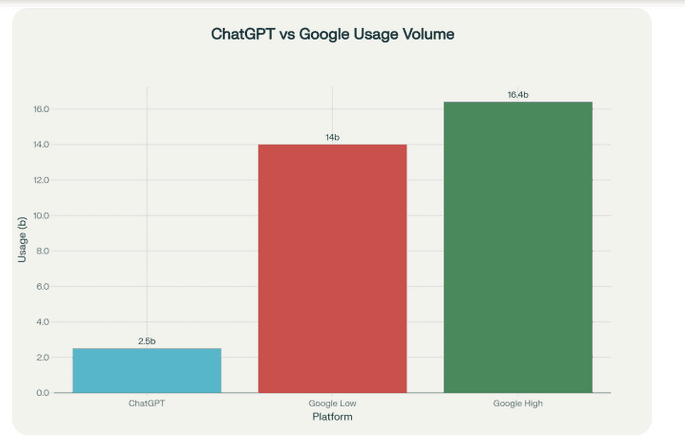
As of 2025, Google reports an estimated 16.4 billion1 searches per day, while ChatGPT handles around 2.5 billion2 daily queries.
To gauge the potential ROI of SEO and AIO (Artificial Intelligence Optimization), we need to put on our thinking caps and try to crunch those massive numbers.
The simple truth is that even genius savants struggle to conceptualize the difference between billions. Humans tend to compartmentalize anything with the B-word as a “really big number” and move on. But 13.9 billion more daily searches is a really, really big number.
The visual aid above really helps to highlight Google’s unwavering iron grip on the internet as a whole. We’re not denying that AI is powerful and on the rise, but traditional search still reigns supreme. The ROI of SEO follows that dominance.
Here’s another major reason why Google’s ring is still worth smooching: even LLM platforms and AI agents get their info from search engine results pages (SERPs). Their citations, recommendations, and conversations are scraped from top-ranking sites.
Simply put, if you’re not ranking in Google, you’re invisible to artificial intelligence, and the ROI of AI SEO is going to reflect that.
So, how can this data inform our next moves? Ultimately, the connection between traditional search and AI queries shows that we’re not at a fork in the road. Rather, we’re in a very unique place: the intersecting point of a crossroads. However, we don’t need to choose just one path.
For now, the ROI of SEO is still a running faucet. Why turn it off? At the same time, the roadmap says we also need to keep evolving our strategies and use traditional SEO as a core tool that capitalizes on the synergetic relationship between AI and traditional search.
The roads aren’t branching away from each other. They’re merging together.
Actionable Steps to Boost AI Visibility
- Use structured data (schema markup) so AI can easily interpret your website’s content.
- Create authoritative, experience-driven content (E-E-A-T) that AI is likely to trust and reference.
- Optimize for natural-language queries and FAQs, since AI tools often surface conversational answers.
- Prioritize branded mentions and high-quality backlinks, which reinforce authority signals that both Google and AI models look for.
- Use bullet points, tables, and comparison charts often for easy readability.
- Keep paragraphs short and focused.
- Include expert quotes or authoritative citations.
What is the ROI of SEO?
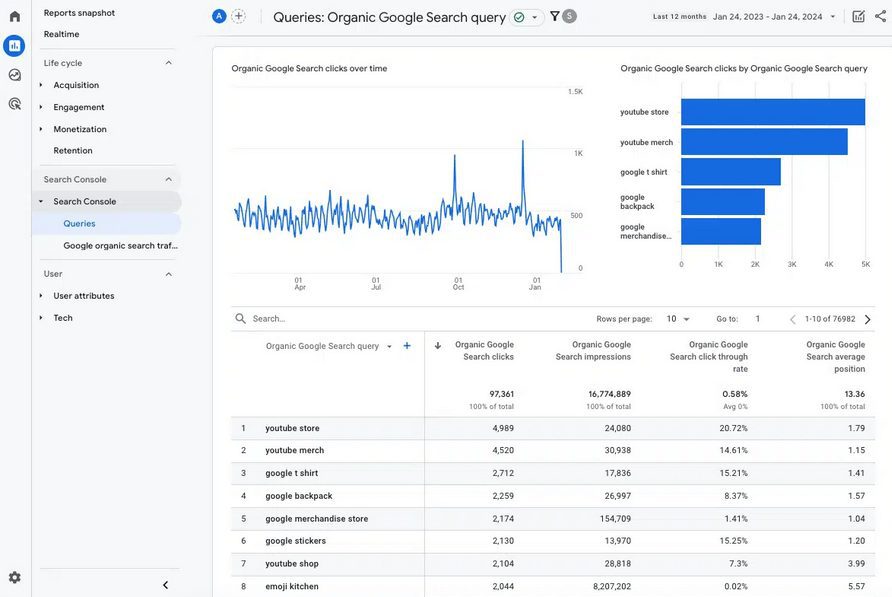
When we talk about the ROI of SEO, we’re really asking: “How much value do you get back from organic search compared to what you spend on it?”
At its core, ROI measures profitability. For SEO, it means looking at how much revenue customers generate who find you through search engines vs. how much you spend on SEO.
The formula is fairly straightforward:
(Revenue from SEO – Cost of SEO) ÷ Cost of SEO x 100
For example, your company spends $5,000 per month on SEO and earns $20,000 from organic traffic. That’s a 300% ROI from SEO. This shows how to calculate your SEO ROI in practice.
Now add in the AI layer.
Those same rankings can secure placements in AI-generated answers, effectively multiplying your reach without multiplying your spend. The ROI of AI SEO reflects this dual visibility. Your SEO dollars stretch further when they deliver results in both search engines and AI outputs.
If your competitors are investing in SEO, they’re not just dominating Google’s rankings. They’re also taking up space in AI-generated answers. In other words, the ROI of SEO isn’t just about Google rankings. It’s about expanding reach into AI-driven answers.
It is important to note that the value of a website visitor isn’t the same for every business. An ecommerce brand may calculate SEO ROI based on average order values and purchase frequencies. A B2B company might tie ROI to lead value and customer lifetime value.
Either way, the goal isn’t about just clicks. It’s about profitable and sustainable growth.
Here’s the kicker: SEO ROI often outpaces the ROI of paid advertising because organic content doesn’t disappear when your budget pauses. And, unlike ads, the ROI of AI SEO carries over into AI-driven answers to potentially double the payoff of your SEO investment.
How to Calculate SEO ROI (Step-by-Step)
Determining the ROI of SEO isn’t complicated, but it does require accurate tracking and realistic assumptions about your customers. Here’s how to do it.
Step 1: Measure Traffic Potential
ROI starts with how many people are actually searching for your services or products. Keyword research tools can help you estimate monthly search volumes, while Google Search Console can help you determine clicks and impressions over a certain period of time.
Step 2: Apply Click-Through Rate (CTR) Benchmarks
Not every searcher clicks. Exact percentages vary based on keyword, user intent, and other factors. However, on average, the #1 organic result captures about 25% to 30% of clicks for a given keyword. According to Backlinko’s research, the precise CTR for a number one spot in Google is 27.6%3
Step 3: Estimate Conversions
Next, apply your website’s conversion rate. This varies widely. A plastic surgeon may convert 5% to 10% of qualified visitors, while an ecommerce store might convert 2% to 3%.
Step 4: Apply Revenue Value
Multiply conversions by the average order value (AOV) or lifetime customer value (LTV). This ties traffic directly to business impact.
Step 5: Compare Against SEO Costs
Finally, subtract your SEO investment to reveal profitability. This formula shows your SEO ROI in black and white:
(revenue from SEO – cost of SEO) ÷ cost of SEO x 100
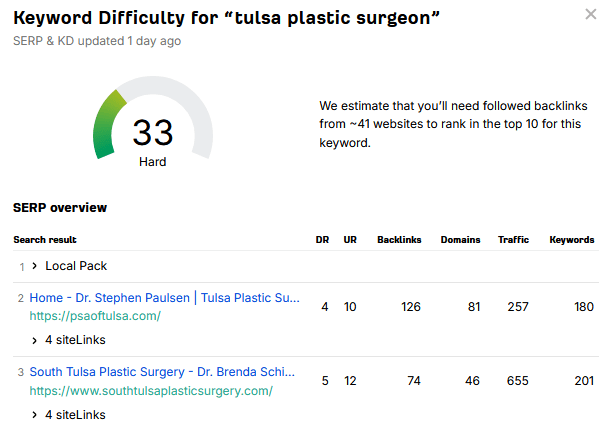
Let’s say you’re doing SEO for a plastic surgery business in Tulsa, Oklahoma. Your goal is to rank the website for “Tulsa plastic surgeon.”
If the following apply:
- Keyword: Tulsa plastic surgeon
- CTR at position #1: 28% = 280 site visits per month
- Conversion rate: 7% (about 20 patients per month)
- Average revenue per surgery: $8,000
- Estimated revenue: $160,000 per month from one keyword
If that surgeon spends $15,000 per month in SEO, their ROI would look like this:
($160,000 – $15,000) ÷ $15,000 x 100 = 967% ROI
Pro Tip for the AI Era
When you calculate the ROI of SEO, remember you’re not just measuring Google traffic. Strong SEO rankings can also secure placements in AI tools, which can help make every dollar invested work twice as hard for you.
The ROI of AI SEO works like a multiplier: one strategy fueling two visibility channels.
How Long Until SEO Provides an ROI?
The time it takes to see the value of SEO depends on factors like:
- Keyword competitiveness
- Domain authority
- Website health
- How aggressively you invest
For most businesses, meaningful results begin within 4-6 months (sometimes 6-12 months depending on competition), with ROI compounding over time as rankings stabilize.
In today’s landscape, speed matters. The sooner you build visibility in Google, the sooner AI tools like ChatGPT and Perplexity can start citing your content.
That’s why the ROI of AI SEO rewards early movers: a strong foundation now can secure a lasting advantage in both search results and AI-driven answers.
Pro Tip
If you want to calculate SEO ROI more accurately, factor in not just projected search traffic, but also the potential multiplier effect of AI visibility. This two-channel return makes delaying SEO more costly than ever.
Harness The Power of AI & SEO Together
At Coalition Technologies, we set clear ROI timelines at the start of every campaign so clients know when to expect returns and how soon those rankings may carry into AI outputs. Let’s begin ramping up your ROI.
Book your free consultation, and get ready to maximize your bottom line!
References:
1. https://explodingtopics.com/blog/google-searches-per-day
2. https://tech.yahoo.com/ai/articles/chatgpt-receives-2-5-billion-164553666.html