



The Rundown
- AI browsers embed conversational AI directly into browsing workflows, changing how products, services, and information are discovered.
- ChatGPT Atlas introduces a browser-native AI experience that blends search, research, and task execution into a single interface.
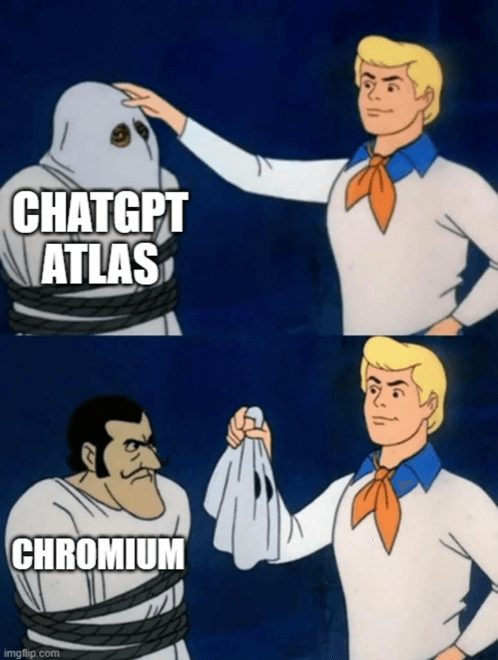
- Atlas is currently Mac-only and built on Chromium, with ChatGPT available at every interaction point.
- Early ecommerce exploration suggests AI browsers may influence which brands are surfaced through authority, comparisons, and community validation.
- From an SEO standpoint, AI browsers seem to reward brands with strong content depth, trust signals, and off-site validation.
- Coalition Technologies is actively evaluating AI browsers to understand their potential impact on ecommerce performance and search visibility.
AI browsers are not theory anymore. They are shipping products and are already influencing how users research, compare, and buy.
One of the obstacles these AI browsers aim to streamline and reduce user effort compared to traditional search functions present on browsers. The new browser from ChatGPT, named Atlas, compresses discovery, evaluation, and decision-making into a single flow, which has the potential to change ecommerce and SEO dynamics.
Coalition Technologies evaluates these shifts early because clients expect measurable outcomes, not speculation. ChatGPT Atlas highlights how browser-native AI may shape future content visibility and ecommerce discovery paths.
Table of Contents
What Is an AI Browser?
An AI browser integrates a conversational AI model directly into the browsing experience. It does not live in a separate tab. It does not require context switching.
Instead, it observes pages, tabs, files, and history to respond with context-aware outputs. AI browser behavior changes how users search and how brands get surfaced.
Examples include:
- ChatGPT Atlas
- Perplexity Comet
- Microsoft Edge with Copilot
Each approaches autonomy differently, but ChatGPT Atlas prioritizes immediacy and flexibility.
Why Atlas Is Different
Atlas is a Chromium-based browser with ChatGPT built in at the system level. It is currently available only to Mac users, which limits adoption but accelerates focused testing.
Key Atlas characteristics observed in Coalition Technologies research:
- The search bar asks whether to ask ChatGPT or enter a URL
- Voice input is native, not layered
- A single “+” enables advanced actions without new tabs
- Browser memory can be used to personalize responses
- Files and images can be referenced mid-search directly
From a usability standpoint, Atlas reduces cognitive load by consolidating search, research, and evaluation into one interface. From an SEO standpoint, that changes which pages win. AI seo becomes less about keywords and more about contextual authority.
Atlas vs Chrome: Consumer Experience
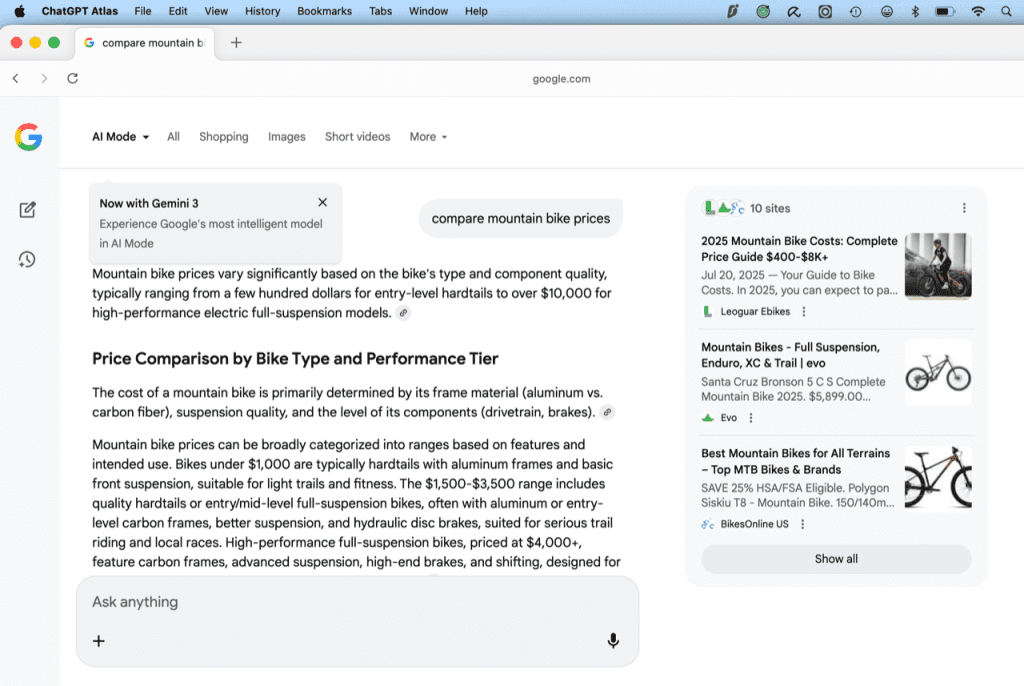
Chrome remains fast, stable, and deeply familiar. Its primary interaction model is still centered on the omnibox: “Search Google or type a URL.” This favors keyword-based queries and page-by-page navigation.
Chrome has introduced AI Mode in Google Search, adding generative answers and follow-up questions. However, the experience remains largely search-first, with limited personalization, shallow context carryover between queries, and minimal support for multi-step reasoning without repeated refinement. More advanced workflows often require switching between tabs, tools, or extensions.
ChatGPT Atlas approaches discovery differently. It consolidates search, reasoning, and synthesis into a single conversational interface designed to preserve context across turns and inputs.
Atlas consolidates these steps:
| Feature | Chrome | ChatGPT Atlas |
| Conversational search | Optional | Native |
| Context from tabs | Limited | Deep |
| File and image prompts | Partial | Integrated |
| Research summaries | Separate | Built-in |
| Preloaded prompts | No | Yes |
The result is efficiency, not raw speed. Atlas reduces friction by centralizing discovery, comparison, and synthesis in one place, minimizing the need to bounce between searches, tabs, and summary tools to reach a conclusion.
FAQs
What is an AI browser, and how is it different from using an AI site?
An AI browser integrates artificial intelligence directly into the browsing experience, allowing the AI to understand tabs, pages, files, and browsing context in real time. An AI site operates in a separate window and requires users to manually provide context, while an AI browser applies intelligence across navigation, research, and content creation without switching tools.
What does the rise of AI browsers mean for traditional SEO?
AI browsers still rely on search engines for indexing and rankings, but they reshape how results are surfaced. Visibility increasingly depends on content clarity, authority, and structure, as AI systems summarize and select information rather than displaying long lists of links.
How do AI browsers affect ecommerce SEO?
AI browsers affect Ecommerce SEO by prioritizing content that explains products clearly, compares options, and demonstrates authority across multiple sources rather than relying on keyword matching alone. This shifts visibility toward brands with strong educational content, third-party validation, and well-structured product and comparison pages.
Is ChatGPT Atlas better than Perplexity Comet?
ChatGPT Atlas and Perplexity Comet serve different use cases, with Atlas focused on a ChatGPT-native browsing experience and Comet emphasizing autonomous task execution. The better option depends on whether the priority is conversational research and content creation or automated browsing workflows.
Preloaded Prompts and Canvas
Atlas surfaces preloaded prompts beneath the search bar to help users explore common workflows more quickly. One of these entry points opens the Canvas tool, a structured workspace for drafting and editing longer-form content within ChatGPT.
This functionality extends Atlas beyond information retrieval into light content production. For ecommerce teams, it may reduce friction between research and early-stage drafting, though outputs still require human review, validation, and refinement.
Embedded tools like Canvas highlight one possible direction for AI browser differentiation, particularly for users who frequently move between research and writing tasks.
Ecommerce Shopping Experience in AI Browsers
AI browsers already show promise for lead generation and service-based research, and they may also influence ecommerce discovery over time. To explore how Atlas behaves in a product-research context, we tested a common ecommerce scenario: early-stage holiday shopping.
To understand how Atlas behaves in a real product-research context, we explored a common ecommerce scenario: early-stage holiday shopping. Seasonal gift research creates high intent, broad comparison needs, and unclear brand preferences, making it a useful lens for evaluating AI-driven discovery.
In this exploration, ChatGPT Atlas functioned more like a guided research assistant than a traditional search engine.
From Query to Comparison in One Interface
The product category chosen was silk pillowcases, a space with wide variation in quality, materials, and price.
That variation matters. Silk pillowcases differ by fabric source, weave, durability, and finish. Pricing ranges from budget options to premium brands with significant markup. A traditional search workflow would require multiple queries, tab switching, and manual comparison.
Using Atlas, the initial prompt focused on value and quality rather than brand names. ChatGPT Atlas synthesized information across multiple sources and presented a structured response instead of a ranked list.
How Atlas Sources Ecommerce Information
Rather than pulling exclusively from brand-owned product pages, Atlas blended several content types:
- Community discussion from forums such as Reddit
- Brand websites with established reputations in the category
- Editorial sources with higher domain authority
- Comparison pages that explained price-to-quality tradeoffs
This sourcing behavior is notable. It suggests that AI-driven discovery may surface brands that clearly explain value and tradeoffs, rather than relying solely on paid visibility or brand recognition.
Atlas also surfaced citations directly within responses, allowing users to drill into source material without restarting the search process.
Product Pages That Surface in AI-Driven Discovery
One notable pattern was the visibility of comparison-oriented pages. In several cases, Atlas surfaced product comparison content that framed affordability through material quality, durability, and cost-per-use rather than headline price alone.
This aligns with long-standing ecommerce best practices. Pages that contextualize pricing and explain tradeoffs provide more value than pages focused solely on promotional language. ChatGPT Atlas ecommerce behavior reinforces that dynamic rather than replacing it.
What This Means for Ecommerce Teams
AI browsers have the potential to compress parts of the discovery funnel by bringing research, evaluation, and comparison closer together. While adoption remains early, these patterns highlight areas ecommerce teams may want to monitor closely.
For ecommerce brands, this creates clear priorities:
- Invest in comparison and educational content, not just product listings
- Ensure product pages clearly articulate quality signals and differentiators
- Support brand authority with third-party validation and editorial mentions
- Treat community discussion and reviews as part of the discovery surface
As ChatGPT Atlas and similar AI browsers mature, ecommerce visibility will depend less on capturing isolated keywords and more on owning the broader product narrative across the web.
Ecommerce Implications Moving Forward
AI browsers do not eliminate traditional ecommerce fundamentals. Pricing, fulfillment, UX, and trust signals still matter.
What changes is where the evaluation happens. AI browser interfaces pull those signals together before users ever reach a checkout page. Brands that fail to provide clear, comparative, and credible information risk being filtered out before consideration begins.
Coalition Technologies will continue to evaluate how these shifts affect ecommerce performance, content strategy, and long-term SEO visibility as AI-driven discovery evolves. Now, onto SEO.
SEO Implications of AI Browsers

AI browsers do not replace search engines. Google, Bing, and other platforms still determine rankings. What AI browsers change is how search results are consumed, synthesized, and filtered before users reach a website.
In tools like ChatGPT Atlas, traditional ranked lists are abstracted into conversational responses. Pages are cited, summarized, and contextualized rather than presented as ten blue links. That shift alters how visibility is earned, even though underlying ranking systems remain unchanged.
From an SEO perspective, this introduces a new layer between rankings and clicks.
Stay Ahead of the AI Curve
Data-driven ecommerce strategies outperform guesswork across AI-driven discovery channels.
How Atlas Surfaces Sources
During hands-on exploration, Atlas responses frequently referenced a mix of content types rather than relying on a single source class.
Those sources included:
- Brand-owned product and category pages
- Editorial reviews from high-authority publishers
- Community discussion from forums such as Reddit
- Comparison and educational content explaining tradeoffs
This blended sourcing model matters. It suggests that AI browser seo visibility depends on credibility across multiple surfaces, not just on-page optimization.
Atlas does not disclose weighting or ranking logic. Any discussion of prioritization must therefore remain observational rather than declarative.
Visibility Is Becoming Contextual, Not Positional
Traditional SEO has long focused on positional outcomes: ranking first, appearing above the fold, or capturing featured snippets.
AI browsers shift that focus. Content is selected because it helps answer a question clearly within context, not because it occupies a specific position on a results page. ChatGPT Atlas seo exposure is driven by relevance, authority, and explanatory depth rather than exact-match keyword targeting alone.
This does not mean keywords are obsolete. It means they are insufficient on their own.
What Types of Pages AI Browsers Reference
One consistent pattern was the visibility of pages that framed information comparatively and educationally.
Examples include:
- Product comparison pages explaining quality differences
- Buying guides that outline use cases and constraints
- Editorial reviews that contextualize pricing and performance
- Forum threads that reflect real-world usage and sentiment
Thin pages designed solely to capture traffic were less prominent in AI-generated responses during this exploration.
This reinforces a principle Coalition Technologies has applied for years: SEO works best when content is designed to answer questions completely, not just to rank.
Authority Signals Matter More Upstream
AI browsers aggregate signals before users ever land on a site. That means authority is evaluated earlier in the journey.
From an SEO strategy standpoint, this elevates the importance of:
- Third-party mentions and reviews
- Editorial coverage from trusted publishers
- Consistent brand positioning across platforms
- Community discussion that reflects authentic usage
These signals are not new, but AI browser interfaces make them more visible earlier in the decision process.
What SEO Teams Should Do Now
Coalition Technologies recommends treating AI browser visibility as an extension of modern SEO, not a replacement.
Practical priorities include:
- Audit content for explanatory depth, not just keyword coverage
- Strengthen comparison and educational assets across categories
- Track where brand pages are cited, not just how they rank
- Invest in off-site validation that reinforces on-site claims
As AI-driven discovery evolves, SEO success will increasingly depend on how well content performs when summarized, cited, and evaluated out of context.
SEO Moving Forward
AI browsers introduce a new consumption layer, but they do not eliminate the fundamentals of search engine optimization (SEO).
Technical SEO, crawlability, performance, and relevance still matter. What changes is how content earns attention once it is retrieved. ChatGPT Atlas highlights a future where SEO is measured not only by rankings, but by whether content is trusted enough to be referenced at all.
Coalition Technologies continues to evaluate these shifts to ensure client strategies remain resilient as search behavior evolves.
What Brands Should Do Next
Coalition Technologies recommends three immediate actions:
- Audit comparison and category pages for clarity and value framing
- Invest in third-party validation through reviews and editorial mentions
- Track citations, not just rankings, across AI-driven experiences
ChatGPT Atlas remains early in adoption, creating an opportunity for brands to adapt ahead of broader usage.
Coalition Technologies continues to test, measure, and deploy strategies that align with how people actually browse. ChatGPT Atlas SEO is not a future concept. It is an active channel.
Final Take
AI browsers reduce steps and emphasize clarity, comparison, and trust within a single interface. ChatGPT Atlas provides an early example of how ecommerce discovery could evolve as AI becomes more tightly integrated into browsing workflows.
Adoption remains limited, but these tools offer signals worth tracking as interfaces, user behavior, and content consumption continue to evolve.
Coalition Technologies works with brands to build SEO and content strategies that remain effective as discovery environments change, whether through traditional search, AI-assisted browsing, or emerging hybrid models.
Footnotes
- Agarwal, Shubham. “The 5 Best AI Browsers in 2026.” November 17, 2025.