
The Rundown
- Bad links arise from spammy, irrelevant, or manipulative sources that offer no SEO value. They can harm a site’s reputation.
- Low-quality backlinks have a toxicity range. It is guided by a risk score that flags inbound links likely to trigger penalties or harm SEO.
- Private blog networks, link farms, hacked sites, spammy directories, paid link schemes, and irrelevant foreign domains are all bad sources.
- Good links are mentions from reputable, relevant sites that send real visitors and signal credibility to search engines.
- High domain authority, contextual placement, natural anchor text, high traffic, and exclusivity make links high-quality.
- Backlink guides rely on creating exceptional, link-worthy assets and building genuine relationships to acquire quality links.
- Agencies bring tested outreach systems, tools, and publisher relationships that win safe, high-value links while saving you time.
Backlinks are the internet equivalent of word of mouth. If you have done something impressive, have something valuable to contribute to society, or do good work in general, people will naturally talk about you. And there is nothing more reliable to a human being than another person’s recommendation whom they trust. In essence, trust builds from trusted sources.
Google’s philosophy of backlinks is guided by the same principle. Its algorithm thinks you are a high-value website if another high-authority site links to you. And the more such sites link to you, the more your value and authority increase in the eyes of Google’s algorithm. It considers good backlinks one of the top three factors for deciding your page’s ranking; the other two being content quality and user experience.1
But unfortunately, like in real life, people try to over-complicate this simple system. Instead of actually doing something worth mentioning, they try to hack their way to a good reputation. Needless to say, Google doesn’t like this. It punishes websites that try to use shortcuts instead of making their name through hard work.
In this backlinks guide, we’ll uncover everything about quality and toxic links. So you can fix your backlink strategy and get your SEO game on track.
Table of Contents
Frequently Asked Questions
What is an example of a backlink?
A backlink is when another website mentions and links to your content. For example, a local blog linking to your restaurant’s homepage.
Do backlinks improve SEO?
Absolutely. Quality backlinks are like votes of confidence. They guide search engines to your site and suggest it is an authoritative and trusted resource.
Should I remove bad backlinks?
Yes. Toxic or spammy backlinks can harm your ranking. Use tools to find them and disavow those you can’t get removed in other ways.
Which backlink is best?
The best backlinks are from highly relevant, authoritative websites in your industry, with a natural link placed in the content.
How to earn good backlinks?
Create exceptional, link-worthy content that others in your niche will naturally want to reference and share as a resource.
Bad Backlinks: Definition, Toxicity, Sources
A poor link is any link from a low-quality, irrelevant, or manipulative source. Examples include link farms, spammy directories, automated bots, or private blog networks. You know, the kind of places you wouldn’t want your brand seen in.
Backlink guides consider these links “toxic.” Not because Google penalizes them outright (in most cases, its algorithms simply ignore them), but because bad backlinks offer zero SEO value. They signal that you might be engaging in shady practices. Relying on them wastes your effort, dilutes your link profile, and in extreme cases, like if you’re actively buying links, can lead to manual actions from Google.
Most of the time, companies attract poor links on purpose. They even pay for it. But sometimes bad backlinks just show up. According to some backlink guides, nearly 30% of backlinks a site receives are flagged as medium or highly toxic, which can be harmful.2
What Is Link Toxicity?
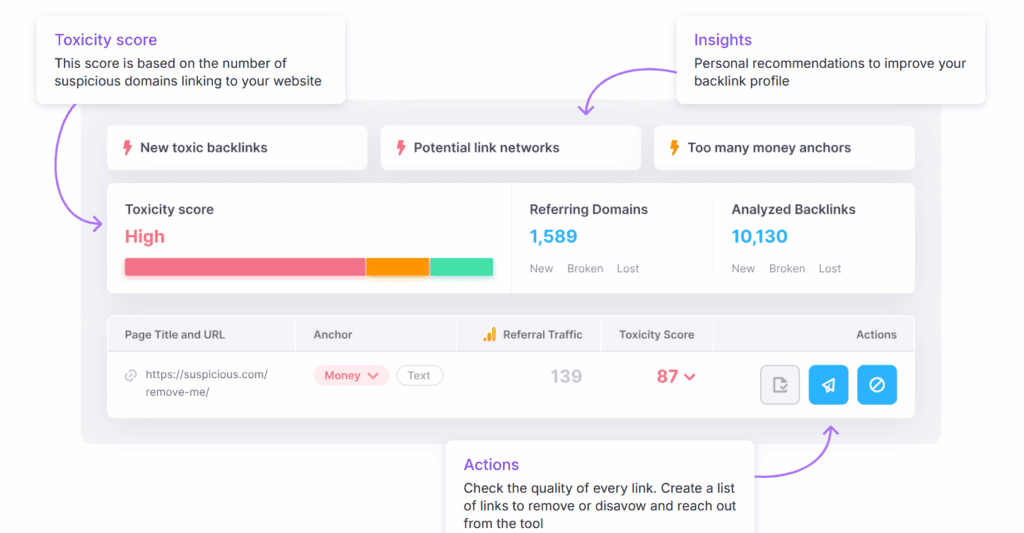
Link toxicity measures how much risk a backlink carries. We trust tools like SEMrush that flag links from suspicious sites. It evaluates links based on over 50 markers to assign a toxicity score.
- Toxic (score 60-100): Come from spam sources like PBNs, penalized domains, or irrelevant foreign-language sites; need to be removed.
- Potentially toxic (score 45-59): May be harmless if contextually relevant, but should be monitored closely.
- Non-toxic (score 0-44): Clean, authoritative, and worth keeping.
Our backlinks guide is built by top SEO experts in the industry. They all agree that if you don’t want to associate your site with spam or risk Google removing your site from results entirely, it’s best to stay away from black hat tactics. Nothing good ever comes of it.
Where Do Toxic Links Come From?
Here’s a detailed overview of the main sources of bad backlinks, their negative impact on your site’s health, and what you should do to fix or avoid them.
| Source | Impact | Advice |
| Paid Link Schemes | These backlinks violate Google’s Webmaster Guidelines directly. It creates a high risk of manual penalties, leading to drastic ranking drops or deindexing. | Never buy links. Reject cold emails offering “high DA” links. Invest in quality content that earns good backlinks naturally. |
| Link Farms and Private Blog Networks (PBNs) | Google’s algorithms are designed to detect and devalue these manipulative networks. Association with them erodes your site’s trust and authority. | Steer clear entirely. Choose transparent, ethical link-building strategies focused on earning links from real websites. |
| Low-Quality Directories | Links from spammy, automated directories do nothing to improve your rankings. They signal to search engines that you’re engaging in manipulative practices. | Audit directory quality. Follow the guidelines and only submit backlinks to reputable, industry-specific, and human-moderated directories. |
| Irrelevant or Spammy Websites | Bad backlinks from sites with unrelated topics, thin content, excessive ads, or poor reputations do no favors to your website. Google’s algorithm knows to ignore these links. | Prioritize relevance and context. Build links from authoritative, relevant, and content-driven sources within your industry, not random, unrelated sites. |
| Forum and Blog Comment Spam | Obvious automated comment links are treated as spam. They provide no real traffic and damage your reputation with both users and algorithms. | Engage genuinely. If you comment, provide valuable insights. Never use bots or mass-submit links in comments. |
| Backlinks from Penalized or Hacked Sites | They are worthless. A link from a site with no authority or trust cannot pass any on to you. Association with these sites can raise questions about your own standards. | Focus on quality. Prioritize earning good backlinks from established, trustworthy sites in your industry that follow Google’s guidelines. |
| Hidden Links | They are a direct violation of guidelines. Using tactics like white text on a white background is deceptive and can lead to manual actions if discovered. | Never attempt to hide links. All link-building efforts should be transparent and designed for users, not just search engines. |
| Automated Link Building Bots | These tools create a large volume of low-quality, irrelevant, bad backlinks incredibly fast, almost guaranteeing a negative SEO impact. | Build good backlinks manually. Quality over quantity is the only sustainable strategy for long-term growth. |
| Adult, Gambling, Illegal, or Pharma Sites | Associating your brand with these verticals can trigger penalties and cause irreparable damage to your reputation and user trust. | Enforce strict sourcing standards. Vet every potential linking domain for quality and content relevance to your industry. |
| SEO Sabotage (Negative SEO) | Although a rare occurrence, malicious competitors may build bad backlinks to your site in an attempt to trigger a penalty. While Google is better at filtering these, you need to be vigilant. | Monitor proactively. Use SEO tools to guide and regularly audit backlinks so you can identify and disavow suspicious links before they cause harm. |
Wondering how many of these black hat tactics you are guilty of? Or whether your site is crawling with bad links, but you don’t even know about it? Find out now!
Good Backlinks: Understand and Acquire Them
A high-quality backlink is a genuine endorsement of one trusted brand by another. These links signal to search engines that your content is worth ranking. Backlink guides say it could be a .edu referencing your research or an industry blog naturally linking to your guide. Or even a renowned news outlet mentioning your company.
Quality reigns supreme here. A single backlink from an authoritative, relevant source can outweigh hundreds of low-quality links. Because good backlinks are earned, not bought. They come from legitimate sites that see your content as truly useful to their audience. No wonder link building accounts for an average of 28% of SEO spending.3
What Makes a Link High Quality?
- Traffic: Pages with active readership and high engagement rates drive visitors. If humans click your link, Google notices.
- Authority: High-domain-authority sites, like .gov or established media outlets, carry more weight. Google trusts sites that trust you.
- Exclusivity: Backlinks from industry guides, awards, conferences, or unique partnerships are hard to replicate and incredibly valuable.
- Relevance: Mentions from within your niche pass more value. A fitness site linking to your supplement store means more than a link from a toy blog.
- Anchor Text: Good backlinks have relevant, natural, and varied anchor texts. They are not over-optimized with exact-match phrases.
- Placement: Links embedded naturally within content (not sidebars or footers) are editorial gold. They’re contextually relevant and reader-focused.
- DoFollow: A genuine dofollow link from a high-authority site is a strong SEO signal. It passes ranking authority from the linking site to yours.
How to Acquire High-Quality Links?
Here is a detailed backlinks guide that outlines the most prominent techniques for acquiring good backlinks:
| Tactic | Implementation | Effect |
| Linkable Assets | Develop comprehensive guides, original research, data reports, or high-value visual content that serves as a reference in your industry. | Becomes a natural link magnet that attracts editorial links due to its usefulness. |
| Guest Posts | Write high-quality articles for authoritative, relevant sites. Include contextual links back to your site that provide value to the reader. | Earns dofollow links from reputable domains while building relationships with industry leaders. |
| Broken Link Building | Use tools to find broken links on relevant websites. Politely suggest your content as a valuable replacement. | Provides a helpful solution to webmasters and gives you natural link placements. |
| Skyscraper Technique | Identify top-performing content in your niche, create a superior version, and reach out to sites that are linked to the original. | Capitalizes on proven content success to earn good backlinks from already-interested publishers. |
| Resource Page Outreach | Find resource pages in your industry and pitch your best content to them. | Gains links from curated, high-value pages. |
| Digital PR | Create newsworthy campaigns, original studies, or trend analyses that earn media coverage and citations. | Generates high-value backlinks from news sites and industry guides. |
| Unlinked Mention Outreach | Use monitoring tools to find brand mentions without links. Request that the mention be turned into a hyperlink. | Recovers lost backlinks. Uses existing brand recognition for good SEO. |
| Expert Roundups | Feature insights from industry experts in your content and ask them to share and link to your site. | Leverages influencers’ networks to earn links and amplify content reach. |
| Strategic Partnerships | Work with other creators for guest post exchanges, co-marketing, and collaborative projects. | Creates a sustainable pipeline for quality links. |
| Community Engagement | Participate in relevant communities, forums, and Q&A sites. Answer authentically. | Provides occasional opportunities to include backlinks in answers. |
Let Coalition Technologies Guide Your Backlink Strategy
Finding bad links and fixing them is no small feat. Neither is building good links. Both take months of effort to even get the ball rolling. And for backlinks to make any tangible impact on your site’s SEO, they need to be an ongoing priority. It’s not a one-and-done thing.
Call the experts at Coalition and let us guide your backlink strategy towards success. As one of the best SEO agencies in the country, our team knows what it takes to execute all of your digital marketing efforts. Every single client who has trusted us with their SEO has seen the astonishing results first-hand.
Just drop us a line, and we’ll turn your backlinks from average to amazing.
Citations:
https://seo.ai/blog/link-building-statistics
https://www.searchenginejournal.com/ranking-factors/top-ranking-factors/