



Coalition paid Clickworker to collect location-specific ranking data. The relationship ended with a disputed $40,000 bill, debt collectors, process servers, and lawyers.
Most Clickworker reviews come from workers asking whether the small online tasks are worth their time. Ours comes from the customer side, and our view is that the company’s billing and work practices look fraudulent. That’s why we’re fighting them tooth and nail. We always pay our vendors on time, and we did so throughout a multi-year engagement even when we had questions about invoice accuracy. But when a vendor appears to be gaming the system and breaking its own contract, we don’t lay down.
We can’t prove intent. A court decides facts like that. What we can do is describe our experience, explain how we reached our opinion, and warn anyone thinking about trusting Clickworker with paid research: marketing agencies, universities, medical and scientific teams, social science groups, AI companies, and any business collecting location-sensitive data.
Table of Contents
Why We Hired Clickworker
We spend a ridiculous amount on third-party rank-tracking software, and we’ve always questioned how accurate some of that data is. Search results vary by location, device, account history, and more. We wanted real people around the U.S. checking rankings so we could audit the software reports we were already paying for.
Clickworker looked perfect: a distributed network of microworkers, billed per completed report. We needed two basic controls. Contractors couldn’t repeat the same evaluation beyond an agreed limit, and they had to complete tasks from the regions we requested. Without those, the work was useless.
The Controls Failed
We repeatedly found contractors completing evaluations more often than allowed, and reports submitted from outside the requested regions. We told Clickworker. Billing discrepancies showed up often, across both its serviced platform and its prepaid marketplace. Multiple executives acknowledged the failures, including CEO Christian Rozsenich. The problems continued anyway.
We don’t know what happened inside their systems. We do know the failures created more billable tasks while producing data that didn’t meet our requirements, and after a while that pattern stops looking innocent. Weak QC happens. Billing mistakes happen. Repeated control failures that increase billable volume, followed by repeated billing problems, are harder to write off.
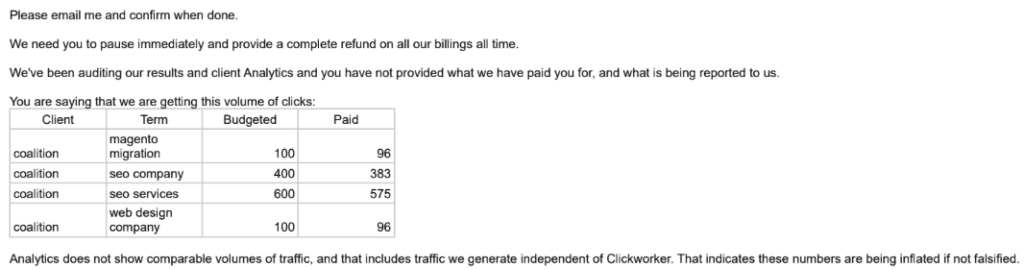
This is the part anyone using Clickworker should sit with: bad geographic controls or repeat workers can corrupt a dataset while still producing a clean-looking spreadsheet. How would you catch it after the study wrapped? And should you have to pay for it?
The $40,000 Bill
As we wound down the engagement, Clickworker presented roughly $40,000 in additional charges long after the work was supposedly finished. We couldn’t verify them against properly controlled, task-level records. Our contract required invoices to be posted within seven business days of completed work. These weren’t. Some were almost a year old.
We objected in writing. In our opinion, the late charges looked like an attempt to bill for work Clickworker couldn’t verify and hadn’t invoiced per the contract, which, given everything that preceded it, is why we believe the demand looked likely fraudulent.
Clickworker then went silent for more than a year.
Debt Collectors Showed Up Next
Our next contact wasn’t from Clickworker. It was from a debt collection company. We disputed the debt and explained why we believed it was invalid. In our assessment, the collection calls didn’t respect applicable timing restrictions, and the collector kept pushing without properly proving the amount.
The dispute later moved to a law firm and process service. Based on our address history, our correspondence, and the court timeline we reviewed, we believe the service claims reflect poor due diligence, and some parts appear inconsistent with court-mandated filing and service deadlines.
The business lesson is already obvious: we should never have relied on Clickworker, and should have cut off the relationship as soon as the signs got troubling.
Why We Believe the Billing Was Likely Fraudulent
Put the sequence together. We reported contractors breaking frequency and regional limits. Clickworker kept billing for the affected work and acknowledged accounting errors throughout, even as they tried to shift us onto a prepaid model. A roughly $40,000 invoice then arrived outside the contract’s posting window, some of it nearly a year old. We disputed it and got a year of silence, followed by collectors and lawyers rather than task-level proof that the charges were valid.
We can’t prove what Clickworker intended. Our good-faith opinion is that the whole pattern looks like likely fraud, not a normal billing mistake.
Should You Hire Clickworker?
Assume you’ll have to audit everything yourself. Get worker frequency limits in writing. Require proof of worker location. Demand raw task-level records. Reconcile every invoice before paying. Save every email, objection, and unanswered follow-up. And test directly for repeat participation, location spoofing, suspicious completion patterns, and workers showing up across supposedly separate sample groups.
A large worker marketplace can produce a lot of data fast, but crap data at scale is still crap data. Our review comes down to this: the controls failed, the billing became impossible to verify, and Clickworker later demanded roughly $40,000 through collectors and lawyers. We believe that bill looked sketchy and likely fraudulent.
We’ll update this post as the dispute moves forward.