In an era of paradigm changes, Google’s dominance seems to be one constant we can rely on, even as LLMs and AI search reshape discovery and shift attention toward AI answers. With a market share of over 90%, and 5 trillion annual searches (approximately 13.7 billion searches per day), it’s clear that understanding how consumers interact with Google will make all the difference for businesses in 2026. Use this Coalition Technologies guide to enhance your strategy with the right stats, straight from the experts.
Table of Contents
- 1 General Statistics
- 2 AI Overviews Statistics
- 3 Desktop and Mobile Google Search Statistics
- 3.1 Over 60% of Searches Come from Mobile Devices
- 3.2 61% of Google Searchers Are More Likely to Contact Local Stores with Mobile-Friendly Websites
- 3.3 “Near Me” Queries Have Grown by Over 200% in Two Years
- 3.4 Mobile Users Visited 3 Pages Per Session, While Desktop Users Visited 4-7 Pages Per Session On Average
- 4 Voice Google Search Statistics
- 5 Technical Google Search Statistics for 2026
- 6 More Interesting Google Search Statistics for 2026
- 7 Harness Google For Your Website
General Statistics
The Best Results See a 22% Click-Through-Rate
The average CTR for a Google search result is between 3% and 5%, depending on your industry. This is why some businesses might be surprised to find out that the first link on a search engine result page (SERP) has an average CTR of over 27.6% across mobile and desktop. By contrast, the 10th link on the page gets a CTR of only 1.9%. This highlights the difficulty and importance of maximizing your CTR for visibility as a growing brand.
15% of All Searches Are Entirely New
Now that we have a general idea of Google’s massive search volume, we can contextualize this statistic. Users seek information on a diverse and ever-expanding range of topics, and they do so in new ways every second. From voice to image searches, how we interact with the world’s biggest search platform has never been more dynamic. We can consider this 2026 Google Search statistic as a sign of things to come with the booming popularity of AI and voice search.
Source: Google
The Google Search Index Contains More than 100,000,000 GB
It might be difficult to visualize this Google Search statistic, especially considering that Google doesn’t even index every page on a website – even for popular domains. This massive index size excludes duplicate pages and low-quality content, allowing Google to provide accurate and fast search results for various terms. It’s a testament to Google’s extensive web indexing capabilities, which enable it to catalog a significant portion of the internet.
Source: Google
Google skews more navigational than ChatGPT. While ChatGPT and other LLMs capture more conversational prompts, averaging about 23 words, classic keyword-style queries are still typical on Google. Brand recognition, habit, and convenience often lead to more navigational intent and, by extension, shorter queries. Monitoring these patterns in Google Search statistics can help businesses understand how customers look for their products.
Other types of search intent include:
- Informational Intent: This is the type more likely to trigger an AI Overview, accounting for 88.1% of those. Users who are looking for general information on a topic. They might be conducting academic research or just answering a particular question. These searches are usually phrased like questions or very short phrases. For example, “When was the printing press invented?”
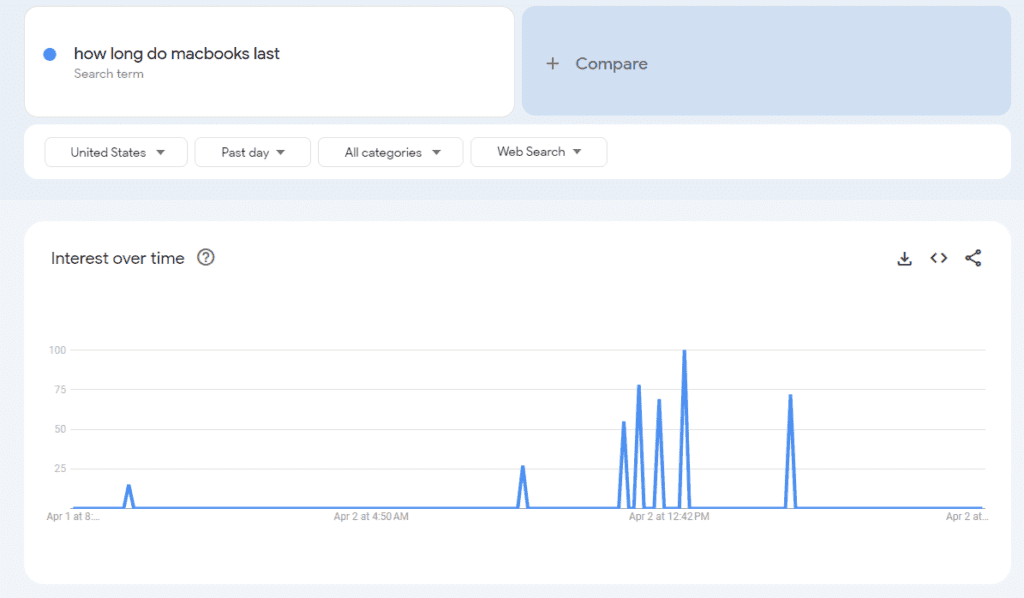
A query with informational intent.
- Transactional Intent: Users who intend to perform an action, like finding and purchasing a specific product. For example, “Buy shoes online.”
- Local Search Intent: This is more of a blend of the two types of intent mentioned above. Local search intent refers to search terms that specify a geographic location like a local store or service.
Sources: Semrush, SimilarWeb
AI Overviews Statistics
13.14% of U.S. desktop searches now show AI Overviews
By March 2025, AI Overviews surfaced on roughly one in eight U.S. desktop searches. Most triggers were informational, with commercial and navigational intent starting to creep up.
Source: Search Engine Land
21% of keywords trigger AI Overviews
AI Overviews appear on 20.5% of all SERPs (29,991,998 out of 146,122,391). Roughly speaking, that means 1 in every 5 keywords generates an AI summary.
Source: Ahrefs
Top-result CTR drops ~34.5% when an AI Overview is present
Across a 300,000-keyword sample, the presence of an AI Overview cut the top organic result’s click-through by about a third. Even the #1 blue link draws far fewer clicks when a summary leads the page, which makes visibility inside the overview and in adjacent SERP elements more important.
Source: Ahrefs
8% vs 15% click-through when AI summaries appear vs not
When an AI summary appears, people pick a standard result less than one time in ten, versus roughly one in six when no summary is shown, and links inside the summary are tapped only rarely. That behavior helps explain why many informational queries now drive thinner downstream traffic.
Source: Pew Research Center
Desktop and Mobile Google Search Statistics
Thanks to improvements in user behavior analytics, we have more information than ever about how consumers interact with Google across multiple devices. In 2026, Google Search statistics can help businesses maximize an omnichannel approach by revealing where their audience truly lies.
Over 60% of Searches Come from Mobile Devices
The fact that most searches come from mobile devices has significant implications for ecommerce businesses. The surge in mobile commerce is also partly due to the widespread expansion of mobile connectivity over the past decade, particularly in developing countries.
It is more important than ever to ensure websites are optimized for mobile devices. This means creating a responsive design suitable for various screen sizes that loads quickly on mobile networks. Additionally, ecommerce businesses should consider investing in mobile apps, which can provide a more streamlined shopping experience for mobile users.
Source: Advanced Web Ranking
61% of Google Searchers Are More Likely to Contact Local Stores with Mobile-Friendly Websites
Customers already prefer shopping from brands that have a reliable presence in their area. You can make that choice even easier by providing an optimized mobile experience. Aside from fast loading times and the ability to adapt to various screen sizes and devices, other mobile-friendly features include:
- Intuitive menus and layout for navigation.
- Push notifications for mobile apps.
- Personalized recommendations based on previous visits and geographical location.
- Streamlined checkout.
Source: HubSpot
“Near Me” Queries Have Grown by Over 200% in Two Years
The surge in local search queries reflects a growing trend of users turning to their mobile devices for immediate, location-based shopping decisions. This 2026 Google Search statistic indicates an opportunity for local businesses to optimize for local SEO and capitalize on users’ intent to make quick purchases.
Source: TheGlobalStatistics
Mobile Users Visited 3 Pages Per Session, While Desktop Users Visited 4-7 Pages Per Session On Average
Getting clicks and high engagement rates on mobile can be significantly more difficult than on desktop. This statistic for Google Search highlights the fact that simply adding mobile-friendly features to your website might not be enough. Consumers treat mobile and desktop searches differently. We can chalk this up to two main factors:
- Info-Rich Results: Mobile search results are much more information-dense than desktop results. Mobile searchers will often have their queries answered by snippets without ever having to click on the source links. Desktop search also incorporates previews, but they are more prevalent on mobile devices – for now.
- User Behavior: Mobile searchers have access to an entirely different set of tools for finding information. For example, someone searching for a nearby restaurant on Google might swap over to Maps to learn more and get directions once they find something in their locality.
Source: Semrush
Voice Google Search Statistics
70% of Google Assistant Queries are Expressed in Natural Language
When people interact with voice assistants like Google Assistant, they tend to use conversational language. They ask questions or make requests as if they were talking to a human. This shift from rigid keyword-based queries to natural language reflects users’ expectations. They want a more human-like experience where they can express themselves naturally and receive relevant answers.
Website owners optimizing their content will have to account for this Google Search statistic in 2026 and onwards due to the growing adoption of voice assistants.
Source: Think With Google
58% of Users Ages 25-34 Use Voice Search Daily
The high adoption rate of voice search in this group reflects a shift in user behavior. Millennials (aged 25-34) have grown up in a tech-savvy environment, making them comfortable with voice-based interactions. New updates to mobile voice assistants and support for voice search on ecommerce websites have also helped with this adoption.
Source: Semrush
Google Lens Was Used 12 Billion Times a Month in 2023
Google Lens is an image search function powered by AI. Users can point their cameras at something they’d like to know more about, and the Google Lens will pull up more information on the subject.
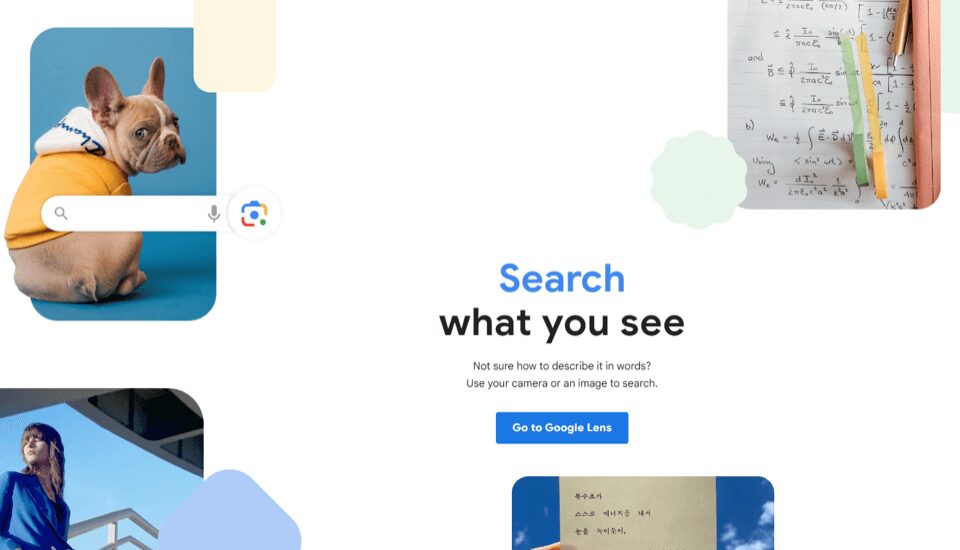
Lens has been around for quite a while now, so we can attribute this Google Search statistic to the platform’s powerful new updates. Accessibility support and text translation accuracy have been significantly improved, and new Google devices with Tensor chips are already building on that strong foundation.
Source: DemandSage
Technical Google Search Statistics for 2026
The #1 SERP Has an Average of 3.8x More Backlinks Than the #2-#10 SERPs
Naturally, high-ranking pages benefit from increased visibility. When users encounter a top-ranking page, they’re likely to link to it when referencing a topic. Being placed as the top result is seen as an endorsement. Google is telling searchers that your page is the most credible and reliable link on a given topic.
Source: Backlinko
50% of Searchers Click On a Result in Under 10 Seconds
From TikTok to Instagram, algorithms have conditioned users to expect faster results and instant gratification. This trend narrows what experts call the “first click window” – the time it takes for a user to make the first click after a search. The top-ranking result naturally has the advantage here, and this statistic partly explains why top results have such high CTRs.
Source: Backlinko
Long-Tail Keywords Get Almost 2x More Clicks
There is an asterisk to this Google Search statistic: it varies from topic to topic. Long-tail keywords contain at least three words, which are much more detailed than short-tail keywords. These keywords are used by people who already have some idea of what they’re looking for.
Long-tail keywords can be much less competitive than their counterparts, making it easier for optimized websites to rank well with them.
Source: Semrush
More Interesting Google Search Statistics for 2026
- Google handles more than 8.5 billion search queries on a daily basis.
- There are approximately 6.3 million searches conducted on Google every minute.
- Google holds a dominant position in the global search market, with a market share of 90%. In the United States, its market share is slightly lower at around 85%.
- According to a survey from Ahref, 96.55% of all indexed pages get zero traffic from Google, and 1.94% get ten visits or less per month.
- Google takes milliseconds to process and answer a query.
- In 2025, YouTube averaged 2.53 billion active users per month (DataReportal).
- More than 20% of the searches in the Google App are done using voice search.
- 46% of the product searches begin on Google.
- According to data from December 2023, 63% of Google’s organic search traffic in the US originates from mobile devices.
- According to Google statistics, 46% of all monthly Google searches have local intent.
- There are 97 billion local searches conducted each month, which breaks down to approximately 3.2 billion daily local searches and around 37,000 local searches per second.
- 78% of local mobile searches on Google lead to offline purchases.
- According to a recent survey from Brightlocal, the top three most trusted platforms for researching local businesses are Google (66%), Google Maps (45%), and a business’s website (36%).
- According to Semrush, the #1 result in Google has an average CTR of 22.4%.
- 84% of search engine users will use Google 3 times a day or more (Oberlo).
- According to a study from WordStream, the average conversion rate is approximately 2.4%, with the top 10% of websites converting at a rate of 11.5% or higher.
- 88% of people who conduct a local search on their smartphone visit a related store within a week (ThinkwithGoogle).
- According to data from Google, around 35% of Americans 18+ are estimated to own a smart speaker (Google).
- “Where is my refund” was the most frequently asked question on Google in 2023. This question generated an average of 15.5 million online search queries per month. “How many ounces in a cup” was the second most popular Google search question worldwide with an average of 8.6 million monthly searches.
- Voice search is used by approximately 58% of consumers to find a local business. Besides, 41% of the adults in the U.S. use voice search daily.
- According to the study conducted by Backlinko, approximately 1/3rd of Google Lens results are pulled from images included in the top web pages.
- Google has by far the largest collection of indexed web pages on the internet, with nearly 65 billion pages in December 2023.
- According to data from Semrush, 38.2% of Google queries are between three and four words long.
- An analysis by SimilarWeb found that of the top 100 Google searches in 2023, 54% were navigational, whether to find a specific website (e.g., “Netflix”) or to find directions to a location (e.g., “cafes in Los Angeles”).
- According to industry benchmarks, paid search results have a median conversion rate of about 3.5% across both business-to-business (B2B) and business-to-consumer (B2C) companies. Meanwhile, organic search results have a median conversion rate of 1.96%, meaning paid search results are 1.54% more effective at converting web traffic into leads (Source).
- Recent Google Search statistics found that nearly 32% of online shoppers started their e-commerce journey on Google. The search engine was outranked only by Amazon (Source).
- A recent survey on artificial intelligence found that 49% are interested in AI-powered search. This means that nearly half of U.S. consumers are likely to use AI-powered chatbots, such as ChatGPT or Google’s Bard, for online search (Source).
- Google organic search is responsible for 57.8% of the world’s web traffic (Source).
- Pages using schema only account for 36.4% of voice search results versus the global average of 31.3% (Source).
- A Yelp page is present in the top 5 results for 92% of search queries that contain a city and business category (Source).
- According to a study from Ahrefs, over 29% of keywords with over 10K+ monthly searches consist of 3+ words.
- BrightEdge found that organic search accounts for 44.6% of revenue across retail & e-commerce, media & entertainment, B2B, technology, travel, and hospitality.
Harness Google For Your Website
These Google Search statistics for 2026 are a reliable indicator of things to come. A business that can take advantage of these stats and quickly adapt its website to match changing preferences will have a massive advantage when it comes to ranking well.
Make that process easier by working with an agency that doesn’t just follow trends, it creates them. Coalition Technologies is a digital marketing agency with nearly fifteen years of experience, creating market leaders with tried-and-tested strategies. Contact us to get a free consultation today.