



The Roundup
- To measure the performance of an AI SEO campaign, watch for a spike in branded searches and higher-intent leads.
- Monitor for rapid journeys from arrival to conversion/lower overall bounce rates.
- Look for and track multiple touchpoints that eventually led to conversions, such as word-of-mouth, discovery, research, engagement, social proof, conversions, etc.
- Check to see if visitors are landing on high-value pages, like transactional pages that include product specs and pricing details.
- Check for positive sentiment on LLM platforms, such as being mentioned consistently (even after updates) and getting recommendations for niche queries.
- Publish on-site content, such as FAQs, blog posts, and product copy, that directly answer Category Entry Point (CEP) questions in a natural language.
AI SEO performance can and should reach far beyond mentions, citations, and even recommendations within large language models (LLMs).
Getting that elusive bump from ChatGPT, Perplexity, Gemini, or Google AI Overview (AIO) is exciting, but if AI SEO results stop at a shoutout, where’s the tangible gain?
Let’s face it: Even the most flattering LLMs aren’t buying products or services. LLM visibility matters, but ego strokes and vanity metrics don’t fuel a bottom line.
Brand awareness helps, but the true ROI of AI SEO comes down to human conversions. An effective AI SEO campaign delivers trackable, real-world value: money in the bank.
So, what does successful optimization look like in the AI era? Here’s how to know if your AI SEO is working.
Table of Contents
Why AI SEO Performance Is Crucial
While AI search drives fewer clicks, the clicks it sends tend to come with higher intent. The average AI search visitor is worth upwards of four times more than a traditional search visitor, and AI traffic is projected by some analysts to surpass traditional search traffic by 2028.1 To borrow a phrase from Oasis: Don’t look back in anger at lost opportunities.
It’s time to start planting seeds and future-proofing, but AI SEO isn’t just a long-term play. Savvy businesses from all industries are currently leveraging LLM platforms as tools for boosting real-world demand and capturing high-intent traffic that converts.
AI traffic is on the rise. In retail, AI-driven traffic is up a staggering 693% year over year. Travel is up 539%, financial services up 266%, software up 120%, and entertainment/media up 92%.2
AI SEO performance determines whether a business slows and stales or grows and scales. Businesses with stagnant AI SEO results are already trailing behind the herd, and we’ve collectively barely crossed the starting line.
Frequently Asked Questions
Is traditional search engine optimization still relevant?
Absolutely. AI search is large and growing fast, but traditional search remains king. For context, 37% of searchers start with AI tools.3 That’s a lot, but it also means two-thirds are still rolling with the classics.
Traditional SEO remains a critical part of effective digital marketing. Furthermore, traditional SEO performance directly affects AI SEO performance. They’re connected. LLMs aren’t recommending businesses that show up on page 23 of the search engine results pages (SERPs).
How to tell if AI SEO is working?
Key AI SEO metrics to watch for are:
- Spike in branded searches
- More relevant, higher-intent leads
- Rapid funnel journey from arrival to conversion
- Multiple touchpoints
- Deeper, higher-value funnel entry points (i.e., arriving on a product page instead of the homepage)
- Positive sentiment from LLMs (not just mentions)
- Becoming the preferred citation source within LLMs (even after updates)
- Specific category entry points (CEPs) (i.e., “formal dress for a dinner party” instead of “formal dress”)
We’ll dive deeper into these indicators of a successful AI SEO performance below.
Can I do AI SEO myself?
In our experience at Coalition Technologies, it takes years of hands-on expertise and a deep understanding of digital marketing to deliver optimal AI SEO results. Successful AI SEO requires a tremendous amount of time, knowledge, and commitment, as well as ongoing maintenance.
Need help with AI SEO? Partner with the world’s best AI SEO agency.
How to Measure AI SEO Success
Next, let’s explore how to know if your AI SEO is working. While a successful campaign may not always include all of the following indicators of optimal AI SEO performance, each one is a telltale sign that it’s on the right track.
1. A Spike in Branded Searches
After an LLM mentions, cites, or recommends a brand, the searcher will often start their own research journey. While this can take place largely within the LLM ecosystem, shoppers tend to seek out other sources, typically through traditional search.
Here’s the difference:
- Normal search: AI SEO pricing
- Branded search: Coalition Technologies AI SEO pricing
Branded searches mean the shopper already has their eye on a specific brand. They’re doing their homework, but they’re already primed and ready to buy.
2. Higher-Intent Leads
If AI SEO performance is stellar, LLM platforms, and especially AI agents, do most of the heavy lifting. Those branded searches usually come from relevant, high-intent shoppers who just got a recommendation from their omniscient digital buddy.
Instead of asking “what” and “why” to buy, high-intent shoppers are searching “where” and “how” to buy.
A lower bounce rate can signify ideal AI SEO results. Visitors from AI platforms will typically stick around longer compared to organic traffic. These high-quality leads are genuinely interested, not just passing through.
3. Rapid Journey to Conversion
Although some visitors from AI platforms will take their sweet time shopping around, others will convert in a matter of minutes or even seconds. That’s a surefire sign of outstanding AI SEO performance. The LLM already did the groundwork that supports a frictionless conversion.
4. Multiple Touchpoints
The journey from arrival to conversion may be brief, but there are often multiple touchpoints along the way. LLMs aren’t usually the last click. They’re the launchpad for kicking off a research cycle that can take days, weeks, months, or even years.
For example:
- The shopper learns about a new sneaker from a friend.
- They ask ChatGPT about it.
- ChatGPT mentions a newer model launching in a few weeks.
- The shopper searches for information.
- The shopper follows the brand’s social media.
- The shopper discusses the upcoming release on Reddit.
- Finally, the shopper buys the shoes.
- The shopper posts their new kicks on Instagram.
- A follower loves them and asks ChatGPT where to get them.
- The cycle continues.
When tracking AI SEO performance, consider the many touchpoints that led to the final outcome. A lot happens behind the scenes after that initial query.
5. Visitors Arrive on High-Value Pages
One easy way to recognize AI SEO results is to track which page visitors are landing on. If they’re coming from traditional SERPs, there’s a high chance they’ll start their journey from the home page.
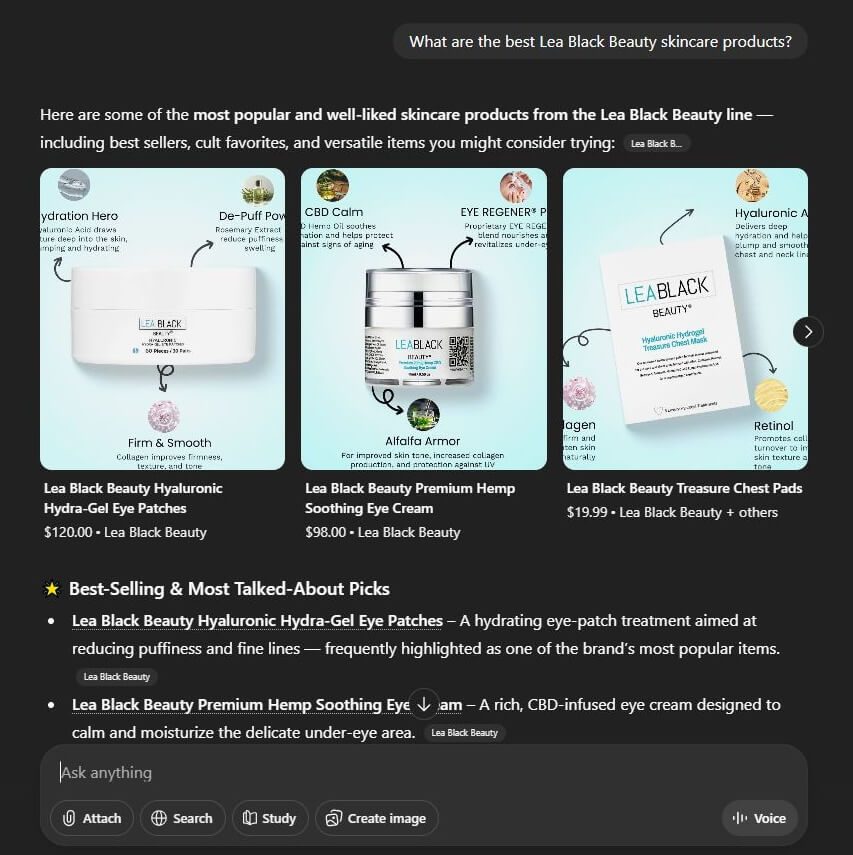
On the other hand, AI-driven visitors often land directly on high-value, transactional pages, like product specifications or pricing details.
For example, I asked ChatGPT, “What are the best Lea Black Beauty skincare products?” ChatGPT provided descriptions of and links to specific products.
On the other hand, when I search “best Lea Black Beauty products” on Google, the top link is to the Best Sellers category page. The AI Overview, however, provides links to specific product pages.
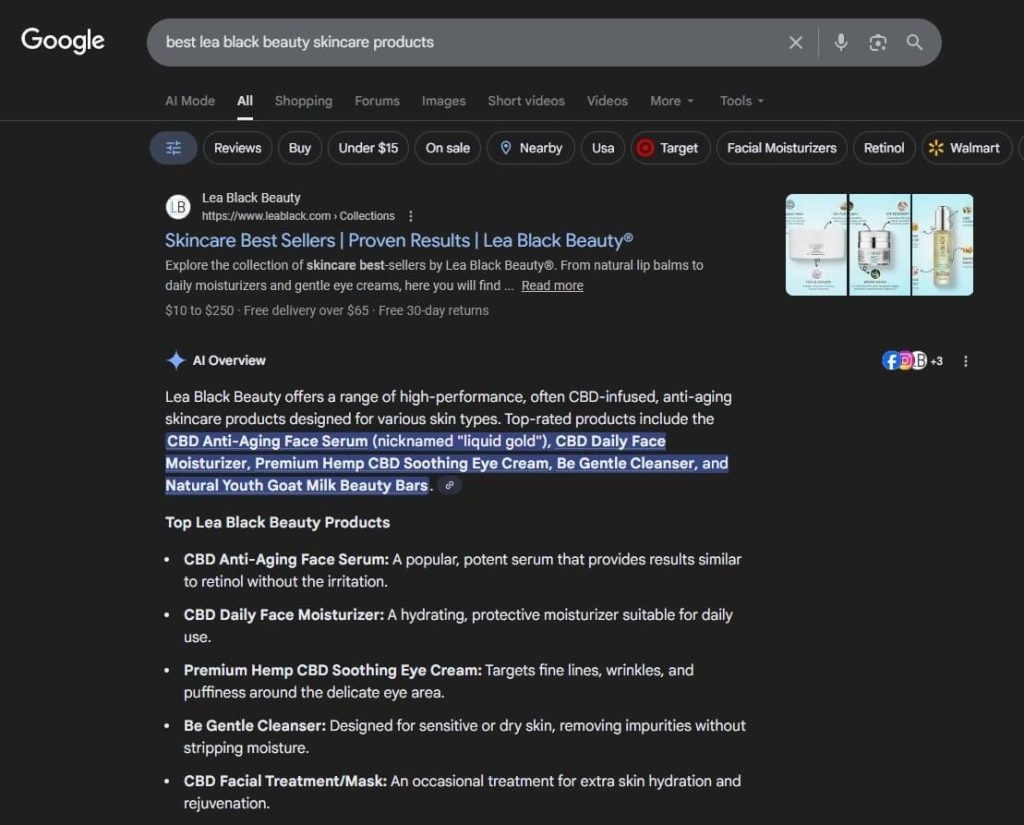
This example clearly shows how AI SEO performance affects how shoppers find businesses and products. A strong presence within LLMs pushes high-intent searchers to high-converting pages.
6. Positive Sentiment on LLM Platforms
Mentions are great and all, but overall sentiment is much more important when determining how to tell if your AI SEO is working.
Is the brand getting recommended consistently, even for vague and broad queries? What about microniche queries? Are they still showing up?
Does the brand keep getting mentioned after updates? There’s a crucial difference between lucking out here and there and having the topical authority that earns the LLM‘s algorithmic versions of trust and respect.
7. Dominating Category Entry Points (CEPs)
Looking for consistent mentions is a big part of analyzing AI SEO performance. However, the goal isn’t only to stand out from the competition and increase brand awareness. Optimal AI SEO results make the brand own specific moments and occasions.
Here’s an example that shows you AI SEO is working:
ChatGPT Query: “Where can I design an ethical custom wedding ring with lab-grown diamonds and recycled precious metals?”
Response:

Our client, Taylor Custom Rings, is at the top of the list. That’s great, but what if we want to dive deeper? Will we still get the recommendation?
ChatGPT Query: “Where can I get an engagement ring that looks like Taylor Swift’s but with ethical diamonds and precious metals?”
Response:

Right in the center, we have a Taylor Custom Rings piece. That’s what successful AI SEO performance looks like. We made sure Taylor Custom Rings gets the spotlight for broad and niche queries alike.
This can be done by publishing pages, FAQs, blog posts, and product content with AI-optimized copy that directly answers those CEP questions in a natural language.
Start Making AI Work for You
At Coalition Technologies, we’ve mastered the delicate art and complex science of modern AI SEO and are constantly fine-tuning our approach to stay ahead of the curve.
These performance indicators will help you understand how to measure AI SEO success, but don’t take the next step alone. Partner with us for real AI SEO results: money in the bank.
Sources:
1. https://www.semrush.com/blog/ai-seo-statistics/
2. https://business.adobe.com/blog/ai-driven-traffic-surges-across-industries3. https://searchengineland.com/consumers-start-searches-ai-not-google-study-467159